Supply chain outsourcing on the rise as uncertainty requires flexibility

Over the course of decades, stable supply chains have been built up to channel products quickly around the world – but a new era of geopolitical tensions and trade wars have cast this into doubt. In response to the new challenges hanging over their logistics plans, a growing number of firms are turning to outsourcers for a flexible response.
Since the pandemic, global supply chains have encountered a historic period of disruption. In response, a growing number of firms are switching suppliers for key services and materials from offshore locations, to help ensure easy access in the future. At the same time, there is a growing trend of firms moving from long-term in-house solutions, to outsourcing for procurement solutions – in order to be able to boost or reduce capacity, as they require.
For nearly three decades, Miebach Consulting’s outsourcing studies have been an integral part of the discussion surrounding the development of logistics value-creation structures. At regular intervals, they provide insights into market trends, decision-making logic, and success factors in logistics outsourcing. The current survey from 2026 builds on the findings of previous studies and examines, in particular, how automation, digitalisation, and the increasing complexity of decision-making processes influence shippers’ outsourcing behaviour.
Most notably from the firm’s latest poll, found the shift to outsourcing is continuing at pace. When asked to assess the future of outsourcing in logistics, 61% of respondents expected it to increase for both their industry and in general.
While that figure had been trending downward since the turn of the century – hitting an all-time low of 51% in 2014 – the period since has seen it gradually track upward. The pandemic era slowed this appetite significantly, as many firms waited to see what the future held – but now, outsourcing expectations are almost on par with those of 2004.
According to Miebach, this outlook for the future also aligns with the respondents’ specific projects. Some 34% of respondents are planning specific outsourcing projects in the transportation sector, 57% in warehousing, and 46% in order picking. In contrast, 3% are planning insourcing in transportation, 7% in warehousing, and 5% in order picking.
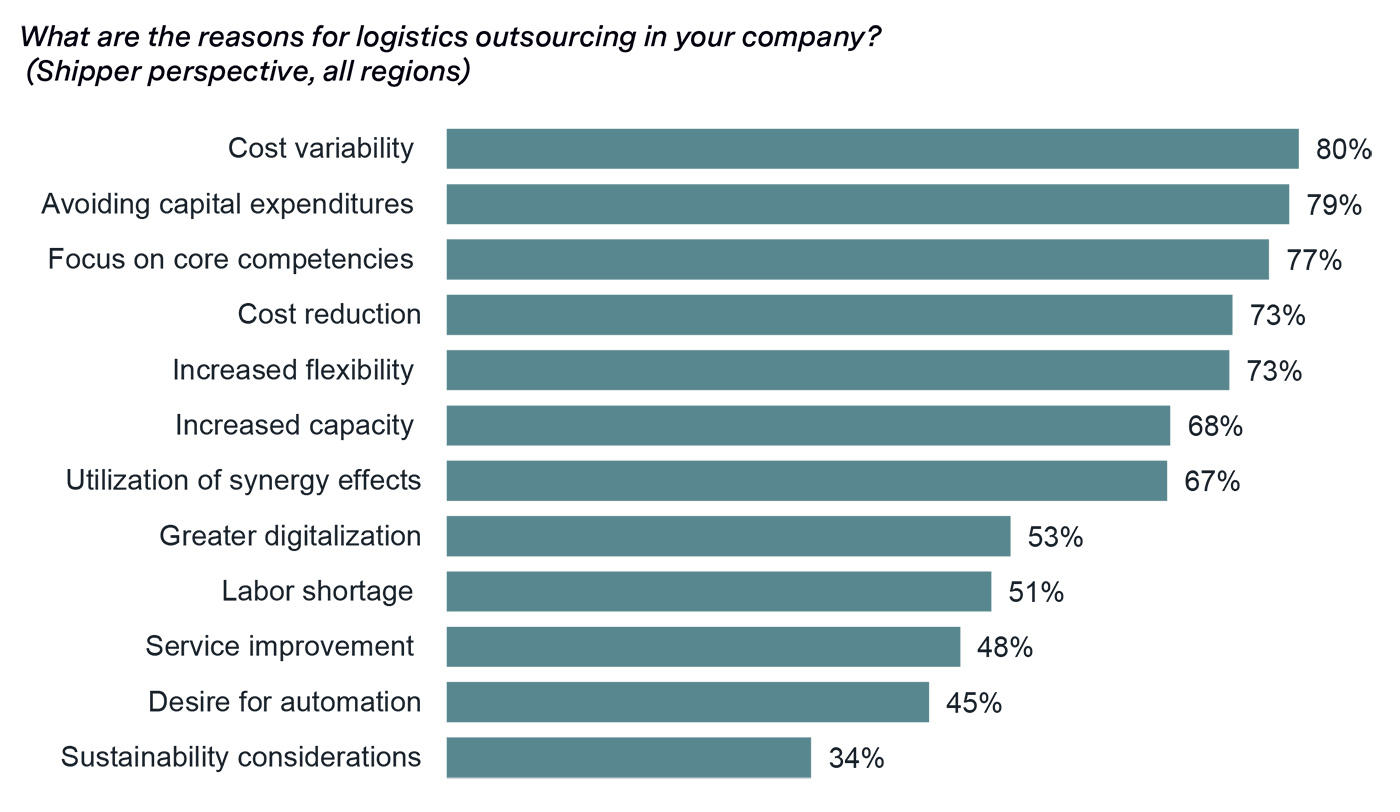
Outsourcing can be a method of ramping up capacity in relation to certain skills. Amid the heightened churn of AI innovation, where new digital skills are in constant demand, this is indeed a driver for outsourcing in supply chain functions. Desire for automation is cited by just under half od respondents as one of the key reasons they are going external. However, this is still not the leading cause.
Cost is king – with cost variability cited by 80% of respondents as why they would outsource for logistics and shipping. Meanwhile, the ability to avoid capital expenditures, as well as the opportunity to find cost reductions, were cited by three quarters of respondents. Increased flexibility was pointed to by a similar number – suggesting the ability to respond quickly to changing market conditions, saving money in the process, is the dominant motivation here.
Professor Bernd Müller-Dauppert and Doctor Klaus-Peter Jung commented in the paper’s foreword, “Outsourcing is no longer an end in itself, but a strategic tool whose success depends largely on the quality of its implementation. A key finding of the study is therefore the realisation that the greatest challenges in outsourcing do not lie in the market itself, but at the interface between shippers and service providers: differing expectations, unclear goal definitions, and shortcomings in tendering, implementation, and governance.”