Going local could pay off for SMEs weighing up public sector tenders

Small and mid-sized enterprises need to build connections on their own doorsteps, as public sector tendering increasingly favours local bids. According to a new study from Procurement Growth Group, more than half of local government contracts analysed were awarded to suppliers registered in the same region.
The UK’s consulting market is estimated at bringing in annual revenues of over £20 billion. It’s second largest client base remains the public sector – with government contracts having driven between one-fifth and one-quarter of consultancies’ incomes in recent years. Winning that work is easier said than done, though.
The strength of the UK’s SME market means that bidding on public sector work has become harder than ever before in recent years. With so much competition at play, applications are increasingly beginning before a formal tender is published, with earlier market engagement, frameworks and alternative routes to market becoming more important for suppliers.
This has been further highlighted by Procurement Growth Group (PGG) research. The firm’s new SME Tendering Market Report brings together PGG’s own tender pipeline analysis, live bid experience, official policy, independent market evidence and expert insight, aiming to give SMEs a clearer picture of where opportunities sit, how buyers are procuring and what is likely to change next.
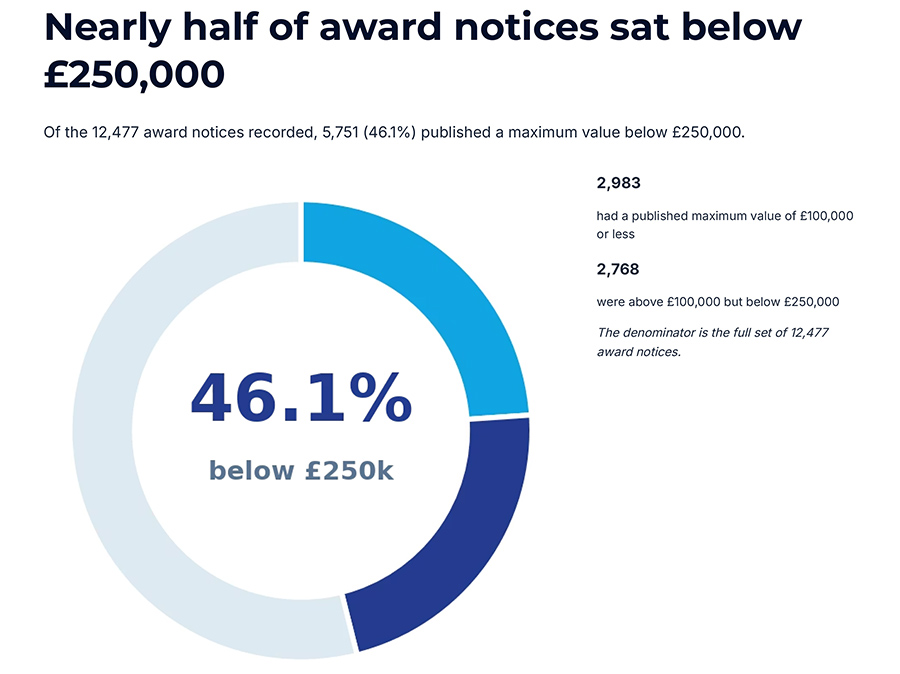
Among the report’s key findings, 46.1% of the 12,477 award notices analysed had a published maximum value below £250,000. Of the award notices analysed, 2,983 had a published maximum value of £100,000 or less. The findings point to a substantial lower-value market where smaller suppliers may have a more realistic route into public sector work, should they prove themselves to be a good fit.
Dave Thornton, group CEO of Procurement Growth Group, said, “There is a huge amount of opportunity for SMEs across the public sector, but one of the clearest messages from this report is that businesses need to be strategic about where they focus their time and resources. For an SME looking to grow in the public sector, the answer is not simply to bid for more tenders. It is about understanding where you are most likely to compete successfully, choosing the right buyers and routes to market, and building the evidence that will help you progress to bigger opportunities over time.”
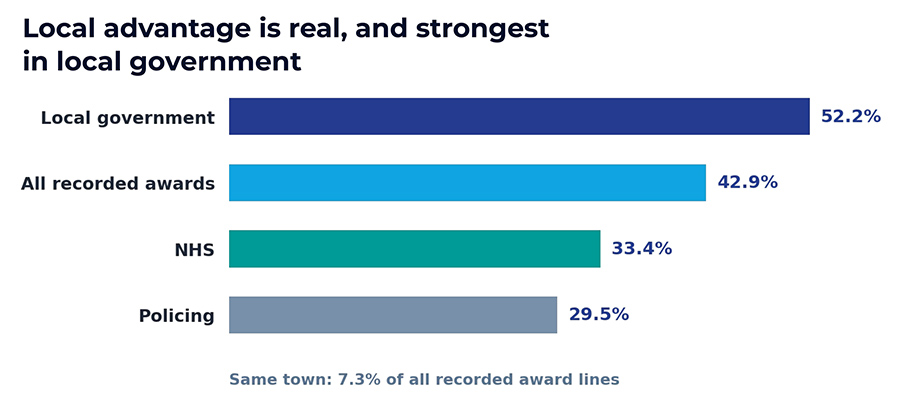
A key element of that suitability seems to be geography. Across the whole public sector, 42.9% of award lines analysed went to suppliers registered in the same region as the buyer. This was even more prevalent when just considering local government awards, at 52.2%. Elsewhere in the public sector, this was also a sizeable minority – with 33.4% for the NHS and 29.5% for policing.
Longevity also was an important criteria for winning bids. The median winning SME in the most recent three-month snapshot had been established for 17.8 years. Meanwhile, just 7.5% were under five years old and only 2.2% were under two years old – showing most clients in the public sector believe stability and a track record which can be double-checked are essential parts of a bid.
Christian Rowe, group commercial director at Procurement Growth Group, concluded, “For some SMEs, the right starting point might be a smaller local contract that gives them a strong reference and measurable evidence. For others, it could be a framework, a subcontracting opportunity or a larger competition where they already have the right experience. Data and early planning can help businesses make those decisions. But ultimately, they still need to demonstrate that they understand the buyer, can deliver what is being asked for and have strong evidence behind their response. The strongest businesses will be those that combine better market intelligence with good bid decisions and high-quality tender responses.”