Cross-border M&A up 31% as geopolitics reshapes dealmaking

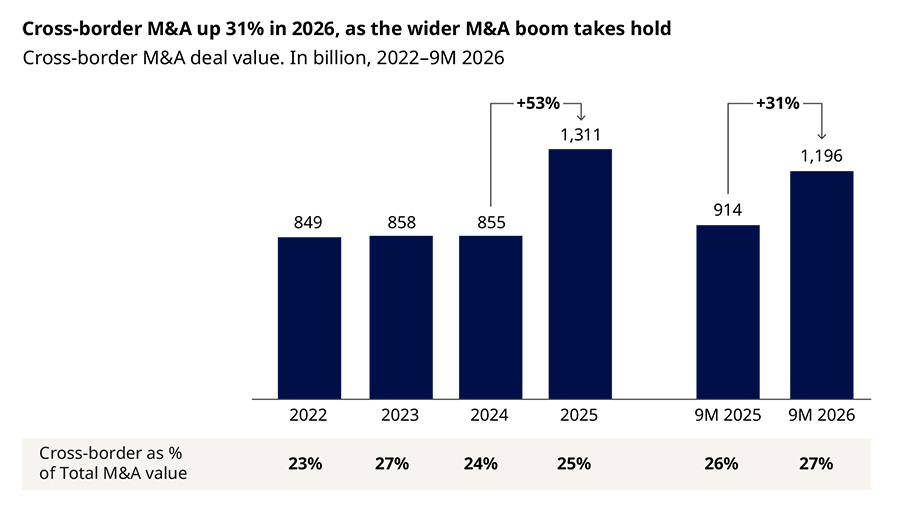
Even amid another year of geopolitical chaos, 2026 is on course to be the biggest year for global dealmaking since 2021’s post-lockdown boom. Activity is up by 31% according to Oliver Wyman, as dealmakers with large amounts of dry powder reshape where capital flows in response to sustained uncertainty.
After an explosion of deals coming out of the pandemic, the global M&A industry has gone through several fallow years. But having turned a corner in 2025, new data from Oliver Wyman now suggests global M&A is heading towards a record year, with cross-border dealmaking growing strongly alongside it.
Buy-and-build has become an increasingly important strategy for dealmakers looking to respond to constant geopolitical change and supply chain disruption. Deals with local firms can offer a helpful alternative to organic expansion – sharing risk and costs while adding new geographical reach. This is pushing cross-border activity up at rapid pace.
According to Oliver Wyman, this is leading to the geography of international investment changing. Activity in the transatlantic corridor is gaining prominence, representing more than half of cross-border deal value in 2026, while Chinese investment in Western markets has declined sharply amid rising geopolitical tensions and regulatory scrutiny.
Cross-border M&A is up 31% year to date, on track for its best year since the SPAC-fuelled 2021 peak. Corporate earnings are at record highs, private equity is sitting on a multi-year backlog of investments they need to exit, and boards have learned to live with the volley of inflation, rates and geopolitical shocks. Technology, Media and Telecoms (TMT), financial services and healthcare represent over 70% of the growth in cross-border M&A since 2024. Large deals are driving much of the uptick, with transactions over $1 billion accounting for 76% of cross border deal value in 2026. Yet, as a share of global M&A, cross-border transactions still represent about a quarter of global value.
Amid this, more than half of cross-border M&A — worth $461 billion in 1H26 — flows through the transatlantic corridor. Transactions involving these markets, including intra-European deals, represented almost 60% of cross-border M&A value in the first half of 2026, up from 40% in 2025. European companies are playing an increasingly prominent role in the transatlantic M&A activity. Their acquisitions of US businesses reached $149 billion in 2026 to date, up more than 70% on the same period of 2025.
Some of this comes from dry powder. Asset and wealth managers entered 2026 with record numbers behind them: $159 trillion in global managed assets and $341 trillion in household financial wealth. However, there were motives beyond this which buoyed activity.
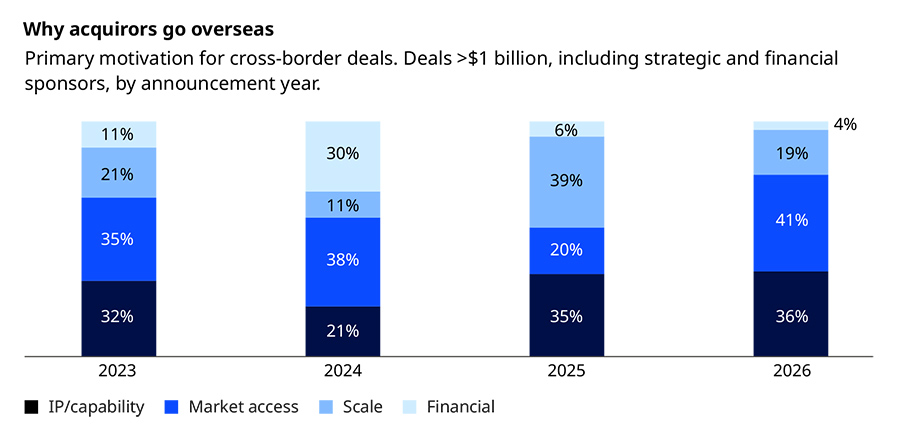
Oliver Wyman’s analysis of 171 cross-border transactions valued at more than $1 billion identifies four principal motivations: access to intellectual property and capabilities, geographic diversification and market access, scale, and financial arbitrage. The first two together account for almost 80% of deals. This suggests that strategic considerations, rather than valuation alone, are driving much of today’s cross-border activity.
Looking ahead, the researchers concluded, “Political and regulatory considerations should inform deal strategy early on in the deal process and seek specialist advice to understand the risks. If companies identify potential barriers, they need to build a long-term influencing strategy to create a positive and robust narrative for the transaction, addressing wider stakeholder concerns. They must also take a balanced view between the financial case and synergies required to underpin it, and the social case. Consider what compromises might be acceptable, and be prepared to flex the value creation plan to accommodate concerns.”