Four-fifths of restructuring professionals expect AI to improve their efficiency

Eight-in-10 restructuring professionals expect AI to significantly improve efficiency and decision-making, according to new research from CSC. The global business administration and compliance solutions provider surveyed 210 professionals globally involved in corporate restructuring or distressed financing, and found that while human judgement will remain central, the technology could ease friction such as manual data entry and compliance databases.
Business change has become a constant in the modern economy, driven by persistent cost pressure, constrained financing, and continuous geopolitical shocks. And the restructuring market is no exception to this – with the work becoming structural, not cyclical, as the conflict in the Middle East is amplifying these pressures.
As the US’ stalemate with Iran reshapes global supply chains and drives tangible increases in energy prices, maritime insurance premiums and shipping lead times, there is now additional operational uncertainty which management teams must respond to, when working to secure the future of a company, or recover assets for investors. Provider selection in restructuring is subsequently about more than scale. Respondents want support that can move quickly, work across jurisdictions, and coordinate multiple execution workstreams without creating new handoffs.
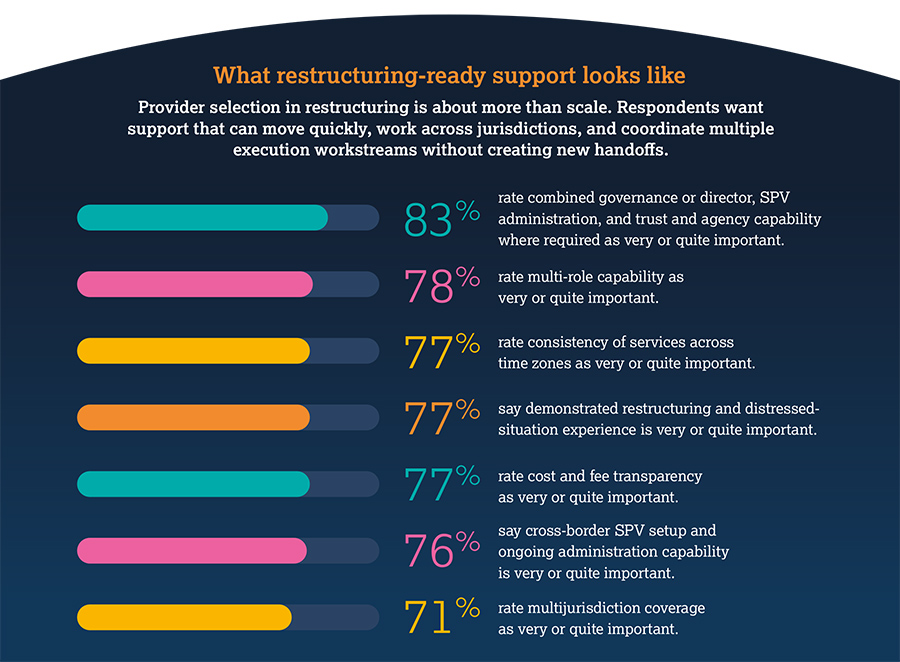
Illustrating this, CSC’s research painted a complex picture of what “restructuring-ready support” looks like. Speaking to clients around the world, the firm found that they are now seeking restructuring experience, cross-border capability, role clarity, and operational coordination when the transaction becomes time-critical.
A leading 83% said that combined governance or director, special purpose vehicle (SPV; a separate legal entity, created just for one project’s assets and funding) administration, and trust and agency capability where required as very or quite important from their restructuring providers. Meanwhile, more than three-quarters also said that consistency of services across time zones, fee transparency, and cross-border set-ups were also high on the agenda.
Efficiency requirements
Jordina Walker, head of restructuring and special situations for the EMEA region at CSC, noted, “Commercial decisions can take months, but once parties know what they want to do, they want to move very fast. At that point, the question becomes less about whether a restructuring route is viable and more about how quickly the necessary entities, appointments, documentation, and support can be put in place.”
But as the expectations of clients diversify, and the challenges each project faces splinter, restructuring professionals are in danger of being spread thin in their work. To that end, a large majority are pinning their hopes to AI to provide a solution – with 82% saying they expect AI to “significantly improve efficiency and decision-making”.
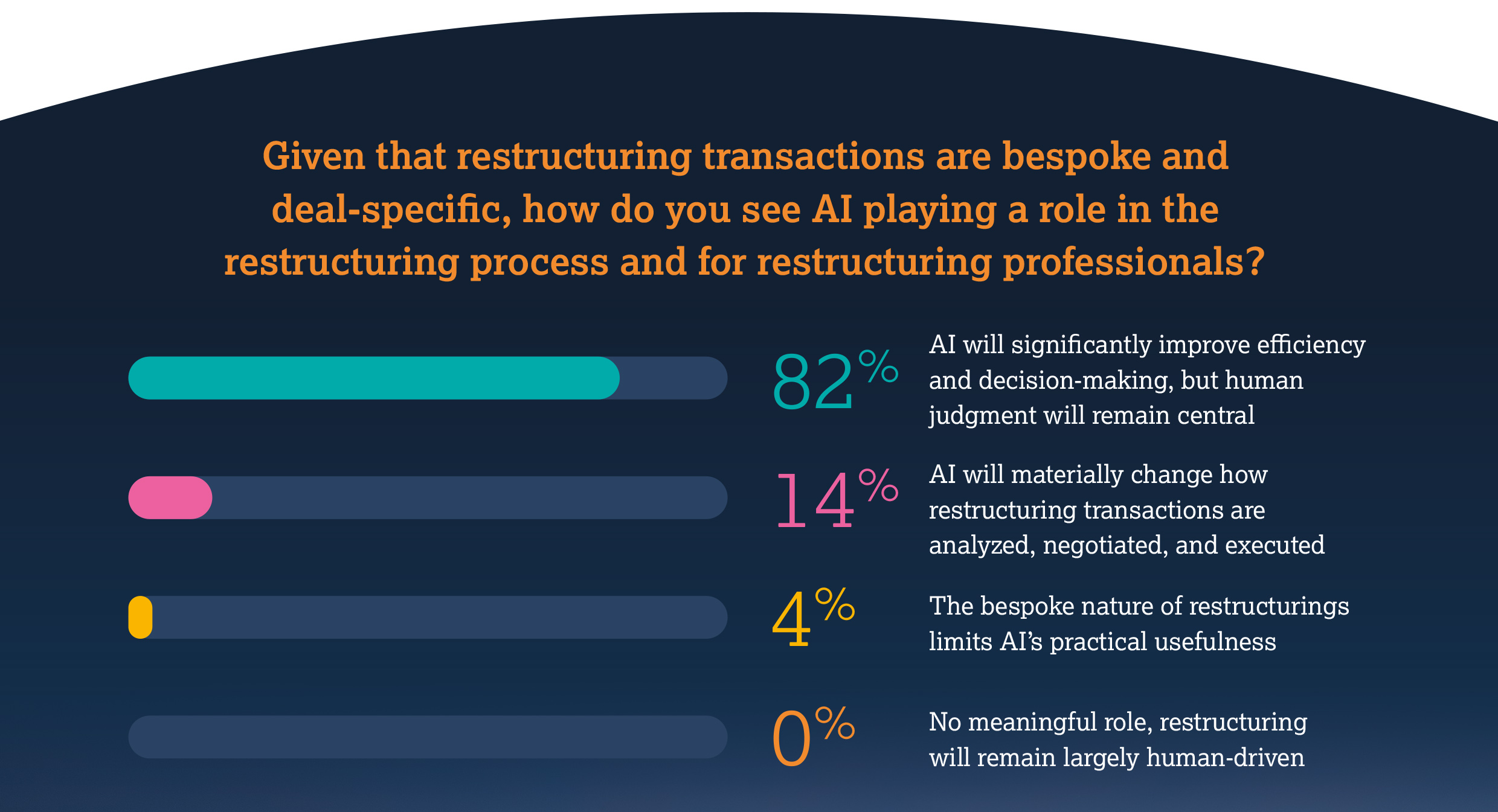
A further 14% at least agreed that AI would “materially change how restructuring transactions are analysed, negotiated, and executed”. Respondents see the clearest potential applications in information gathering, KYC mapping, communications, administration, and monitoring areas where AI could help reduce friction and accelerate processes rather than replace professional expertise.
At the same time, according to CSC, operational readiness and experienced human judgment will remain critical to successful execution. This is especially the case because execution risk is spread across several interconnected operational challenges, rather than one single bottleneck. Respondents noted that clarifying roles and responsibilities and administering SPVs or restructuring vehicles efficiently across jurisdictions are joint leading challenges, each cited by 43% of respondents. Managing cross-border complexity and time zones follows closely at 42%, while 39% point to the speed of onboarding or appointment, including AML/KYC.
Sean Foronjy, director for corporate trust and agency at CSC, concluded, “AI has the potential to support decision making and streamline some of the behind the scenes work that goes into the restructuring process. But technology works best when it complements experienced professional judgment. The real opportunity is in combining the right tools with people who understand the complexities of restructuring and know how to apply them effectively.”