Six-in-10 consulting firms targeted by cyber-attacks since 2023


Research from Deltek‘s 2026 Clarity Report reveals that 60% of consulting firms have been targeted by a cyber-attack in the past three years, highlighting the cyber risk facing professional services businesses. However, fewer firms see bolstering defences as a priority than any other professional services segment, suggesting consultants may be over-confident in their defences, as attacks ramp up elsewhere.
Recent research published by the UK government found the scale of the cyber threat facing UK businesses is greater than ever before. The government’s Cyber Security Longitudinal Survey found that 82% of medium and large businesses suffered a cyber incident in the past year – wreaking a huge economic toll on Britain as a whole.
As threats escalate, however, organisations are also realising the benefits of taking action early. Adoption of cyber essentials among larger companies has risen from 23% to 30%, reflecting a growing understanding of the need for basic cyber protections.
Now, a new survey from Deltek has shown how this trend has been repeated – and accelerated – across the professional services sector. The ERP and software firm specialises in supporting the project-based economy, and polled 375 senior leaders across the sector at the start of 2026, as part of its annual Clarity Study. This included 200 professionals from the UK.
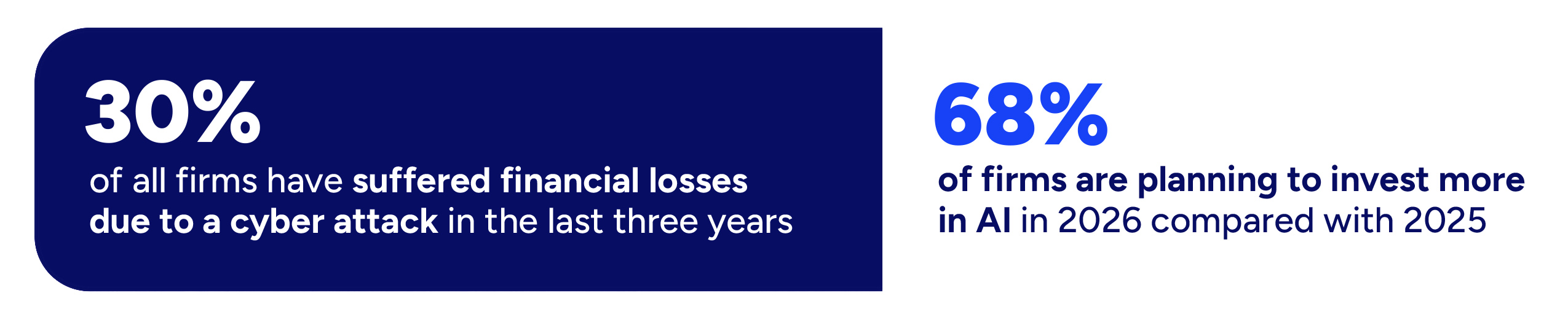
The findings were stark, when it came to the current situation. Some 30% of all respondents said their firm had suffered financial losses as a result of a cyber-attack, in the last three years. Two-thirds said they had been targeted by an attack in that same time, with 52% saying they were extremely, or very concerned for the period ahead.
Amid this, however, organisations are pushing to elevate their cybersecurity investments and governance – leading to leading cyber-maturity, and the adoption of new technologies as a core element of boosting operational resilience. For example, 68% are planning to invest more in AI in 2026 compared to 2025 to bolster their threat detection and response.
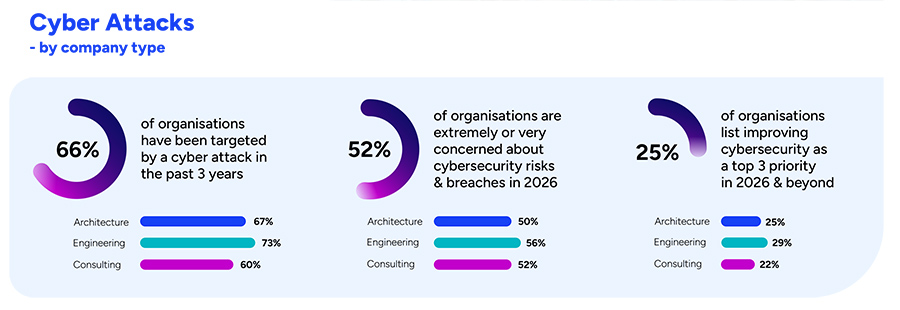
This is not uniform across the professional services sector, however, and Deltek’s findings might make for unsettling reading for clients of consulting firms in particular. According to the survey, advisory firms did see a lower-than-average rate of being targeted – 60%, compared to 66% across the whole sector – but this may have led to consultancies having a false sense of security.
Consultants were less concerned for the coming months than engineers (though more concerned than architects). But ultimately, professionals in consulting said their organisation was less interested in improving cybersecurity in 2026 and beyond, than either other segment. Only 22% of consultants listed it in their top three priorities, compared to 25% in architecture, and 29% in engineering.
Considering the sensitivity of the data consultants have access too, that might be a cause for concern. Especially because, across professional services firms, common attacks include customer or client data breaches (28%), ransomware or malware affecting internal systems (28%) and intellectual property breaches (27%).
Becca Harness, chief information security officer at Deltek, said of the findings, “Clients bring consultants into many of their most important business decisions. That often means access to the confidential plans, data and intellectual property that a cybercriminal would find valuable. So even if consultancies are less likely to report attacks than architecture and engineering firms, that doesn’t lessen the responsibility they carry.
“I’d encourage consultancy leaders to think of cyber resilience as part of the service they provide. Elevating it above an internal IT function provides a clear point of differentiation and commercial opportunity. Protecting client information and keeping projects on track strengthen trust today and help firms compete confidently, especially as expectations around data security continue to rise.”