Half of senior leaders now believe AI generates value at firm

Enterprise AI is starting to deliver, according to a new study from Boston Consulting Group. Almost 50% of respondents to the consultancy’s 2026 Applied AI Index survey said their company now generate value from AI, as organisations move beyond experimentation and begin to scale.
With financial gains often slow to materialise, and revenue or service-delivery impact concentrated below 10%, fears over returns on investment are still a leading barrier to AI adoption. But according to Boston Consulting Group, a new business case is emerging, as firms find ways to finally scale the technology across their organisations.
BCG’s analysis, based on a survey of more than 1,300 c-suite and senior leaders across more than 20 sectors, examines how companies can turn AI ambition into enterprise impact, regardless of their starting point. Of the full set of companies analysed, 7.5% are future-built (the most AI-mature), while another 41% are scaling, meaning that they create some value from AI but have the opportunity to do more.
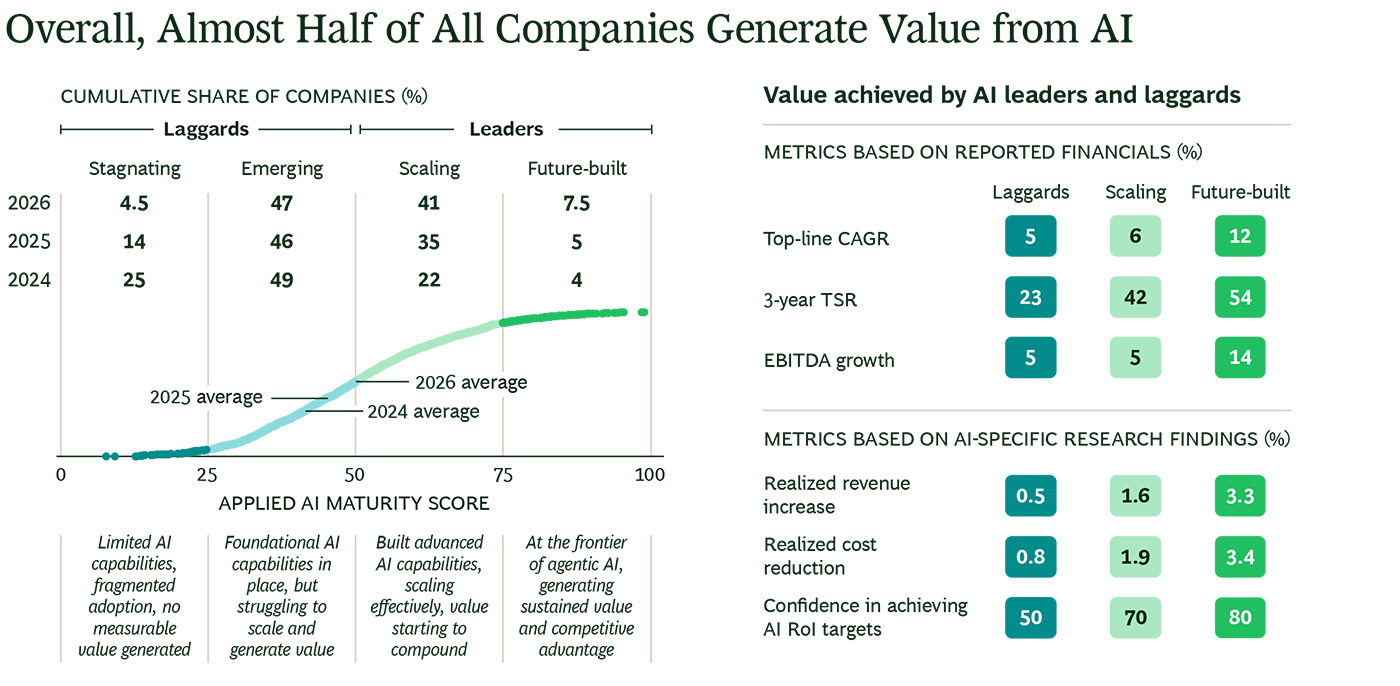
With the majority of firms at last escaping the delays of ‘pilotitis’, there are promising signs for the businesses currently scaling, according to the researchers. Among future-built companies who have already progressed beyond that stage, 61% have moved to a multiyear, enterprise-wide programme of AI implementation. And according to the testimony of their senior leaders, these firms show 2.4 times as much top-line growth as companies in the bottom half of the survey sample.
As a result, almost half of companies now generate value from AI at their firm – up from around 40% in 2024 and 2025. And while revenue growth, even at leading firms, is slow – 3.3% for ‘future-built’ firms, 1.6% at ‘scaling’ – confidence in realising a return on their investments is high. An 80% chunk of the leading AI implementers now expect to see ROI, followed by 70% of those scaling.
BCG contends that this success among ‘future-built’ firms hinges upon strategic clarity – or the need for companies to connect initiatives across the enterprise while anticipating where advantage will shift, focusing on a few high-value, end-to-end plays, and tracking outcomes. Future-built companies concentrate AI into a single, coherent program that targets the company’s biggest opportunities and business priorities. They make the C-suite responsible for the program, and 95% of them use clear KPIs or directly track the P&L value from AI.
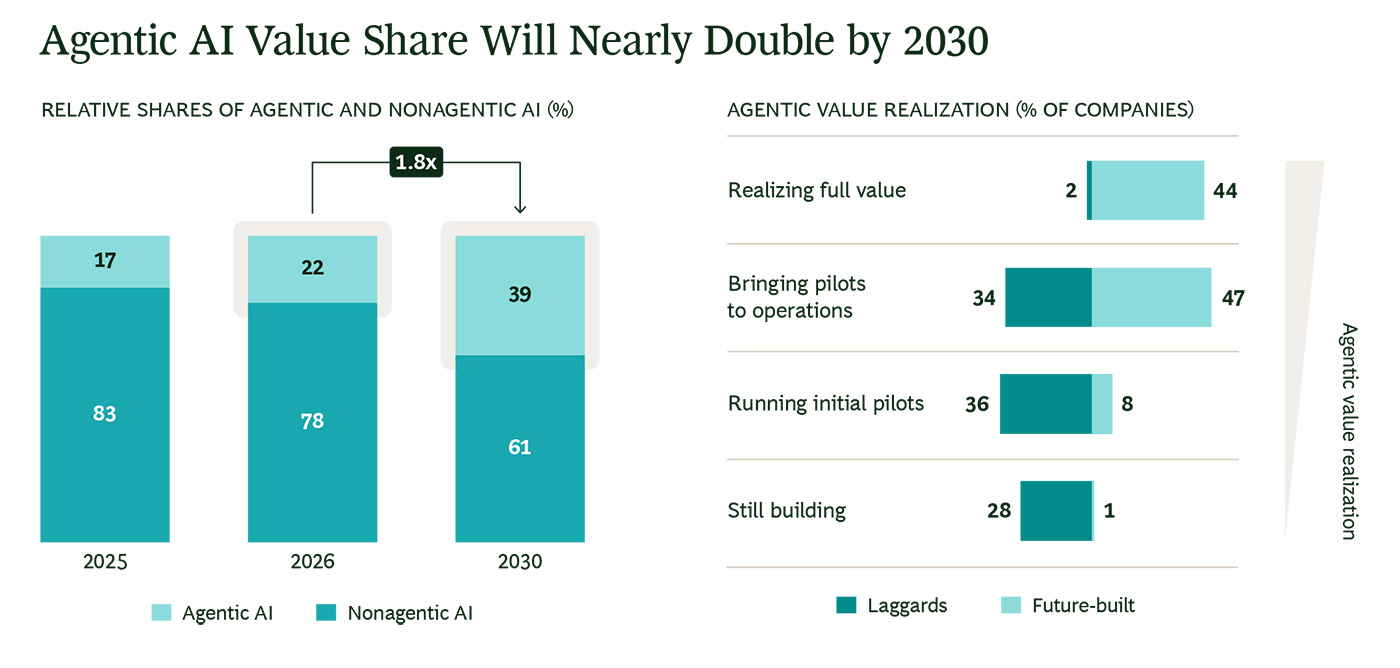
That puts down the foundations required for the next stage of implementation – which BCG asserts could see the modest revenue boosts rise sharply in the coming decade: applied AI, driven by agentic models. BCG claims that the agentic share of total AI value has already climbed from 17% in the 2025 sample to 22% in the 2026 sample, and it is on track to reach 39% by 2030. What’s more, 44% of senior professionals from future-built firms told the consultancy that they already realise value from agentic AI today, whereas only 2% of ‘laggards’ said the same.
BCG explained, “These companies put the centralized risk and control guardrails in place to manage growing numbers of AI agents that operate with increasing autonomy, knowing that effective risk controls serve as an enabler, not a brake. In our data, companies with all six AI controls in place across the enterprise generate three times as much agentic AI value as companies with just one control.”
Progress?
So, what kind of progress does this represent? Often in the early stages of digital transformation, confidence exceeds capability. Business leaders are regularly found to overestimate the results their policies yield, and underestimate the importance of the skills their workforce bring to the table. The AI goldrush since 2022 has been no exception to this.
In the last year, there has been a mounting suggestion that the potential of AI might only be applicable to certain business models, at particular moments in their development – there is a growing focus on returns on investment regarding the technology. Meanwhile, papers have also shown that CEOs have seldom supplied learning opportunities which workers feel would help them AI transformations succeed.
BCG’s research might suggest that firms are finally turning a corner – with the C-suite apparently bullish on the miscellaneous value that the technology provides. However, it should also be considered that since AI has gone mainstream at businesses, multiple studies have also shown that corporate leaders seldom consider, or understand, how to measure ROI on their AI transformation.