The five leaks contributing to your value gap

As leaders and organisations navigate complex change, a value gap often emerges. New analysis from Project One suggests five overlooked areas may be costing firms dearly amid their transformation ambitions.
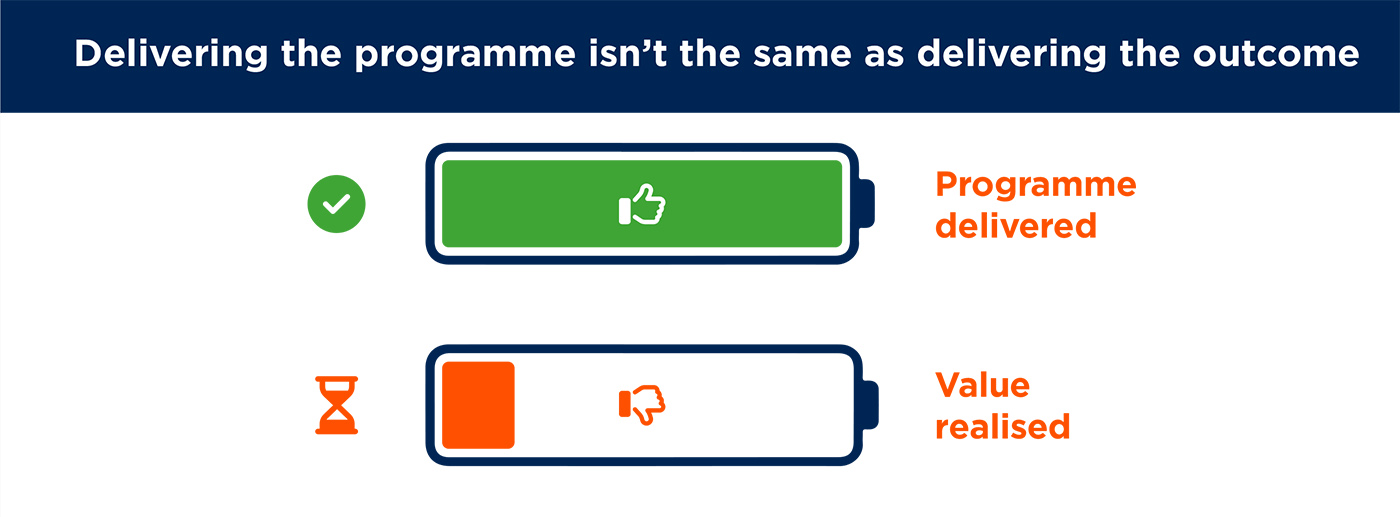
The proportion of transformation value that never reaches the organisation has always been a concern for businesses looking to maximise profitability. But in the era of huge and recurring investments in digital and AI technology, the ‘value gap’ is something no firm can afford to neglect.
Illustrating this, Project One gave the example of a hypothetical business case, which promised £100 million in benefits – including greater productivity, lower operating costs, faster decisions, and improved customer outcomes. To any firm swept up in the AI hype of the past four years, that likely sounds familiar.
While the programme absorbed the usual scars – scope changes, slipped milestones, a business case revisited more than once – the programme went live, the technology was implemented, the new operating model was stood up, the steering committee moved on. But 18-months later, when someone finally asks how much of that £100 million was actually realised, the honest answer is: nobody really knows. And again, with many bosses admitting they don’t really understand how to measure returns on AI investment in terms of income, that similarly sounds familiar. But changing this will require scrutiny across the organisation – with five overlooked areas of leakage in particular.
Leak 1: Leadership alignment
“When leaders are not genuinely aligned, the organisation receives mixed signals,” the researchers explain. “One director talks about the change with conviction; another quietly hedges, protecting their team from disruption “just in case.” Employees are highly attuned to this ambiguity, and they take their cue from what they see and experience. Without visible, consistent leadership, people naturally default to familiar behaviours. Leadership isn’t governance or simply approving investment; it is behaviour that others choose to follow.”
Project One’s experts say that closing this leak means treating leadership alignment “as a deliverable in its own right”. In other words, a small group of senior sponsors who have worked through what the change truly means and costs them personally, need to agree on a single narrative, and be prepared to be visibly and consistently accountable for it, from the first to the last part of a change project.
Leak 2: Middle managers
Middle managers are supposed to translate strategy into action – and face down resistance to change in the process. Without them, adoption will fail. But many were never meaningfully consulted on the future state they are now expected to champion; and when they are overstretched, can often be forced back to the old process “just for now,” protecting their team from extra workload, or simply not modelling the new behaviours because nobody is measuring whether they do.
“Value leaks here in a thousand small daily decisions, invisible to any programme dashboard,” the paper notes. “Closing this leak means equipping and incentivising middle managers as change agents, not just recipients of change. Giving them the tools, the time and a stake in the outcome, and measuring their teams on adoption of the new way of working, not just delivery of the old one.”
Leak 3: Change capability
Operations start to falter when people are left to navigate change on their own – and while many organisations have become “highly capable at delivering projects”, fewer have become equally capable at managing change. Communications and training build awareness and skill, but they don’t, on their own, build sustained new behaviour. Without this genuine change capability, organisations repeatedly re-invent the wheel with each transformation, never building the muscle that would make the next one faster and cheaper.
Project One recommends, “Closing this leak means resourcing change as a core capability, not an afterthought – engaged early enough to shape the design, skilled enough to work with data and behavioural insight, and retained long enough to see adoption become a habit, not a headline.”
Leak 4: Benefits ownership
Benefits of any change exercise are operational outcomes that require clear ownership, measurement and ongoing intervention long after go live. While technology or infrastructure enables them; the business delivers them. But once a programme is underway, attention shifts to scope, schedule and budget; the benefits case is often “filed away for now.”
“The deeper issue is ownership,” according to Project One. “Benefits are typically “owned” by a business case on a slide, and not by a named individual with the authority, incentive and accountability to actually realise them. When nobody owns a benefit, nobody actively drives its delivery. And when nobody owns a number, nobody is accountable when it doesn’t materialise. Closing this leak means naming a benefits owner for every material line in the business case, tracking realisation with the same discipline as budget and schedule.”
Leak 5: Reinforcement
Early adoption can disappear when support, coaching and leadership visibility fade – especially when go-live is misunderstood as the finish line. That is actually the point at which value creation begins – and failure to support these changes after go-live means people drift back to what they know. This is a well-understood pattern in behavioural science: new habits need repeated reinforcement to become permanent, and organisations rarely plan for this beyond the first few weeks.
The paper concludes, “Closing this leak means planning reinforcement as deliberately as go-live itself – sustained leadership visibility, recognition of the behaviours you want to see, and a mechanism to spot the drift and course correct for months, not weeks, after the programme formally closes. The organisations that realise the greatest returns don’t celebrate go-live; they reinforce the change until the new way simply becomes ‘the way we work.’”