Championship football clubs face balancing act between competition and financial sustainability

Leonard Curtis has launched its first edition of the Football Finance Report, ranking clubs in the EFL Championship based on their financial and sporting performance. The research particularly warns that the current system of parachute payments for teams recently relegated from the Premier League risks creating a two-tier league, and stifles competition – with all four top revenue-generating clubs in receipt of the payments.
The inaugural Leonard Curtis Football Finance Report – which includes a foreword written by former footballer Matt Jarvis – was launched at an event at the National Football Museum in Manchester on 16th September attended by over 100 guests, including EFL club CEOs, sports finance leaders and media.
The new report features a first-ever Financial Performance Index for the Championship, ranking clubs based on their financial and sporting performance for the 2024/25 season (the most recent where financial data for the year is available) – and highlights a major challenge to the Championship’s long-held reputation as being the most exciting division in the English football pyramid.
Former West Ham, Wolves and Norwich City player Jarvis, commented at the report’s launch, “My experience tells me that the greatest asset the Championship has is the competition itself. It is relentless. It is physical. It is unpredictable. It is emotional. The challenge for the clubs, the league and the wider game is to preserve everything that makes the Championship so special while finding a more sustainable financial model for the future.”
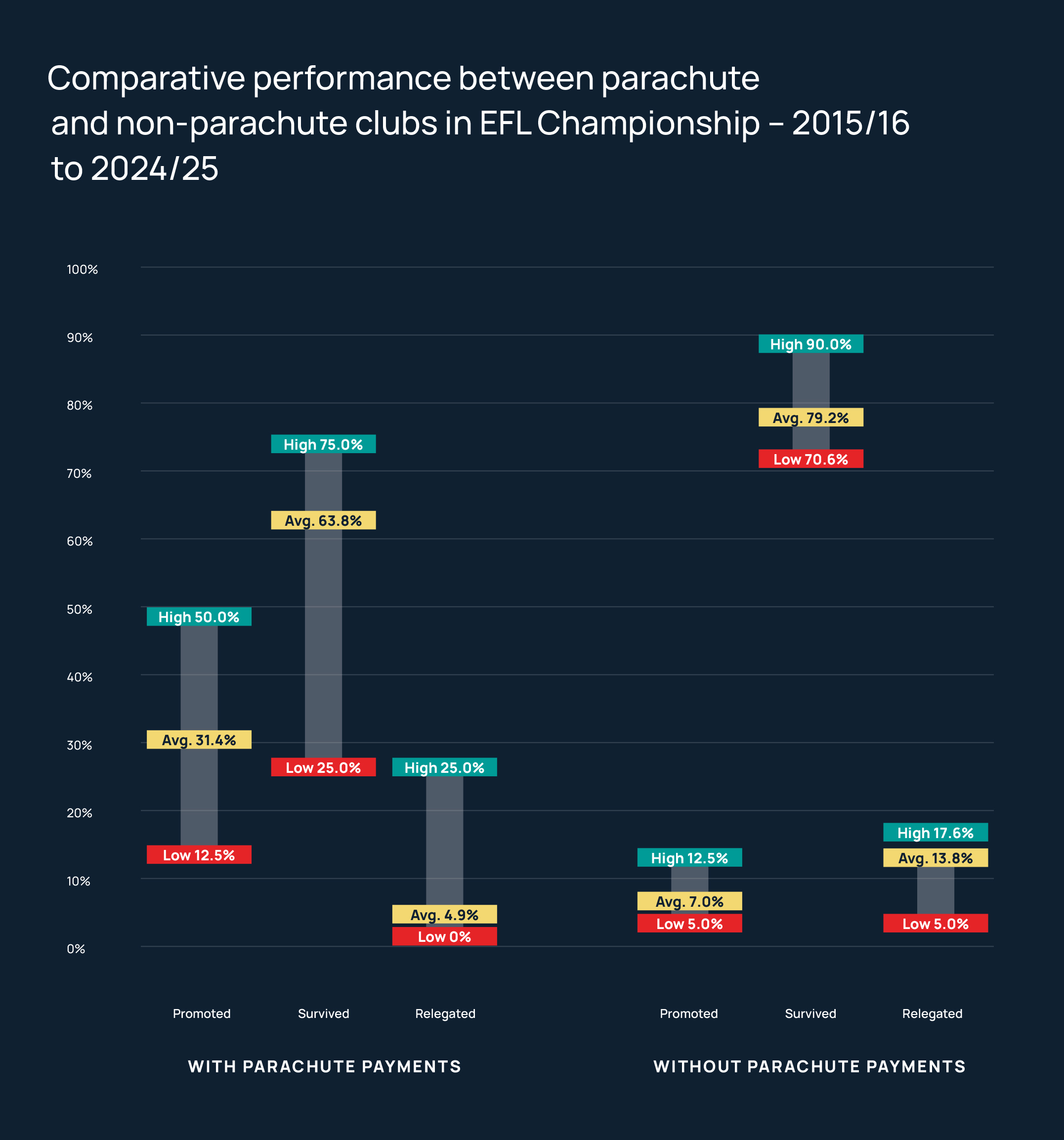
The top four revenue-generating clubs in 2024/25 were Leeds United, Sheffield United, Burnley and Luton Town – all in receipt of parachute payments. Those four teams alone saw revenues total £363.9 million, made up almost 40% of the league’s entire revenue £920.3 million in 2024/25 – something which in theory could enable them to maintain heftier wage bills, and maintain top-tier talent.
To that end, in 2024/25, Leonard Curtis found that parachute clubs had an average 26.8-point advantage in their final league results, with topping the table, followed by Burnley and Sheffield United. However, it is worth noting that Luton went on to be relegated, apparently proving parachute payments are still not an absolute guarantee – something which also happened to Leicester City in the following campaign.
At the same time, the Championship does have a system in place which theoretically dampens this advantage. While money talks over the course of a league season, one-off matches still retain an air of unpredictability – something which meant it was Sunderland, not Sheffield United who ascended to the Premier League via the play-off route. And while legal matters were at the heart of Southampton’s similar failure to bounce straight back to the big time via the next year’s play-offs, the end-of-season contest shows there is fierce competition in the Championship yet.
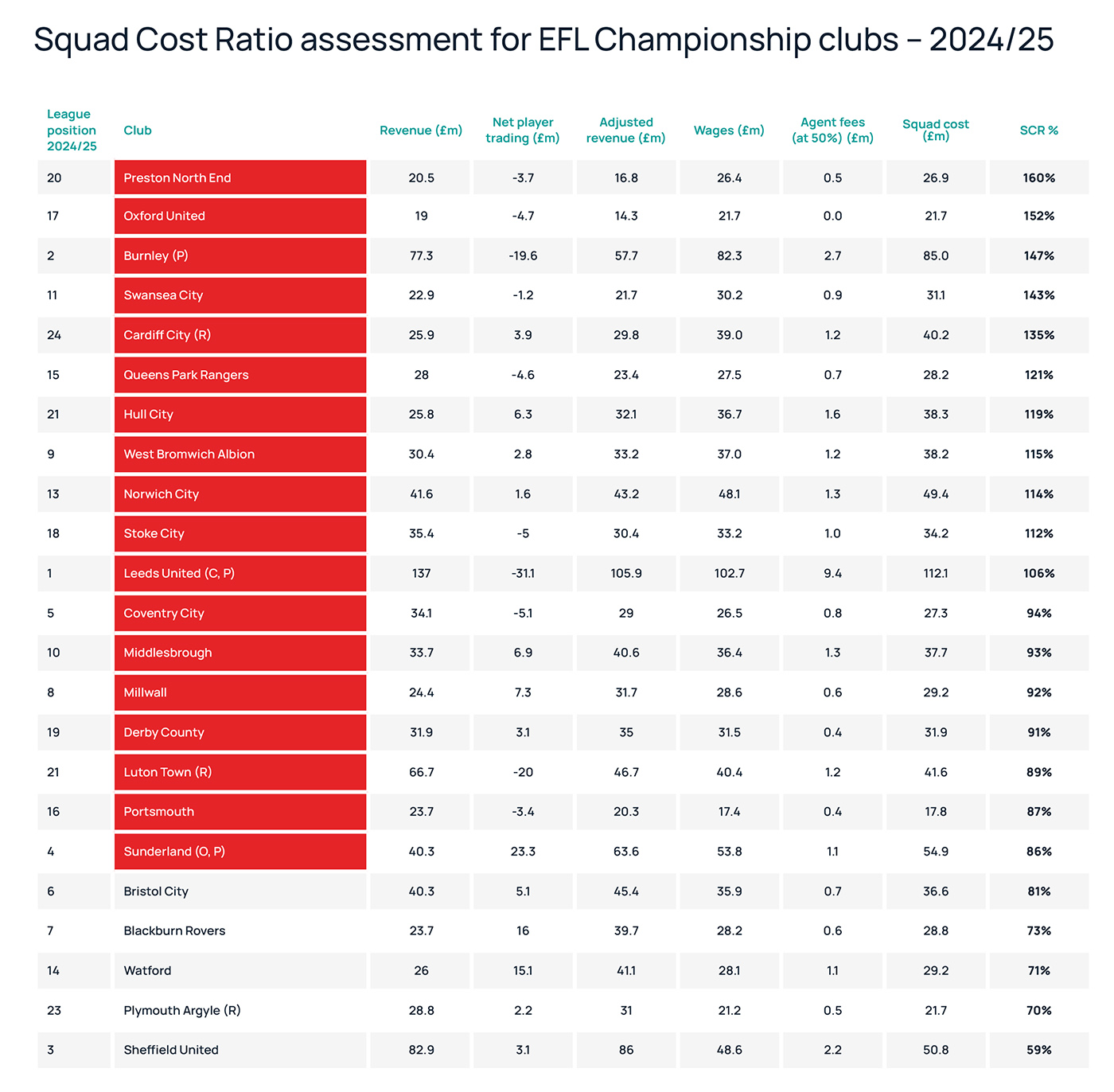
The issue is, how sustainable that competition may be. In order to keep pace with the clubs in receipt of parachute payments, the majority of clubs in the league are spending beyond their means. In a bid to prevent an increasingly regular occurrence of a team falling into relegation, and effectively being relegated via points deductions by Christmas each year, the EFL is now implementing Squad Cost Rules (SCR), where each club’s spending on player and manager-related costs, including transfer fees, is limited to 85% of its income.
The new rules permit owners to make a flexible equity top-up allowance of £34.3m over a three-year period, of which no more than £16 million can be used in any one season. Applying the new SCR retrospectively to 2024/25, this report’s analysis finds that 18 of 23 reporting clubs would have breached the 85% threshold, with 11 above 100%. Preston North End would have been at 160% and Oxford United at 152%. While pushing clubs to restrain this spending might make them more sustainable as a going concern, however, there is a risk that it could inadvertently favour parachute clubs even more – unless that system is also reformed.
Alex Cadwallader, a director and insolvency practitioner at Leonard Curtis, concluded, “The overarching story to emerge from this report is the growing structural inequality in the Championship, alongside a financial model that remains difficult to sustain. The Championship is a near £1 billion league that cannot control its wage bill. It is a financial paradox, with record revenues across the league, unsustainable spending and yet a promotion race increasingly tilted towards the richest clubs.”