Circularity and new extraction methods could alleviate energy transition supply chain issues

As the energy transition continues, the demand for the minerals and metals required to build the green energy infrastructure is growing. But to fully decarbonise the economy, businesses and governments will have to formulate plans to work around the growing geopolitical and trade tensions, jeopardising access to those materials.
Since returning to power at the start of the year, Donald Trump has regularly tried to undermine clean energy adoption. On a recent visit to Scotland, the US president once again bemoaned the wind turbines as “the ugliest you’ve ever seen”, while incorrectly arguing it was the most expensive form of energy generation (onshore wind is now one of the cheapest forms of new electricity in the US, with its 2023 levelised cost standing at approximately $33 per megawatt-hour, lower than fossil gas on $45, and coal at $70).
What exactly the leader of a country whose economy brings in $117.16 billion from oil exports alone would have to gain from this is anyone’s guess. But polling suggests Trump has a long way to go to shift public opinion – with wind farms being far more favourable in the UK than he is. Around 80% of people in Britain support the use of onshore wind energy, while only 4% oppose onshore wind energy, and just 1% strongly opposing. More than three-quarters would even support a new project near them.
Perhaps a more effective tactic to prevent renewable uptake with the US’ allies will come as a by-product of the country’s increasingly hostile approach to global trade. By increasingly driving a wedge between China and the rest of the world via the ongoing trade wars, Trump may be making it significantly more difficult to scale the green energy revolution.
Concentrated supply
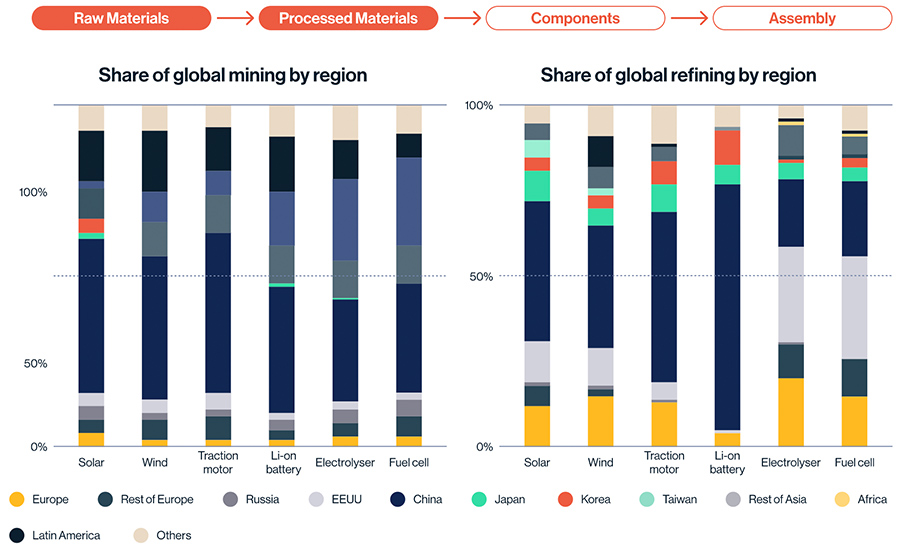
A new report from Metyis has highlighted the fact that solar and wind technologies in particular rely on critical minerals to function. Wind turbines use rare earths like neodymium and terbium in their magnets, along with large amounts of copper. Solar PV meanwhile uses silver, polysilicon, and often gallium or germanium in high-efficiency cells. According to the International Energy Agency, the vast majority of solar PV supply-chain capacity is in China – with more than 80% of modules originating from there.
Further to this, Metyis notes that the production of many energy transition minerals is highly concentrated even outside of China. The top three producing nations account for more than 75% of global output, with some instances where a single country is responsible for nearly half of the total supply. This concentration is even more pronounced in processing activities, where again, China dominates the value chain.
With the possible introduction of huge tariffs continuing to hang above international markets, sharp fluctuations in lithium, nickel, copper, and rare-earth prices drive both CAPEX and OPEX volatility. This reduces returns across energy transition projects such as hydrogen, storage, and hybrid plants. But according to Metyis, governments and businesses do still have options available to try and work around this volatility.
Workarounds
Regulatory levers have been pushing for manufacturers to secure localised supply chains. For example, in Europe, the Critical Raw Materials Act (CRMA) establishes 2030 targets of at least 10% extraction, 40% refining, and 15% recycling within the bloc, while limiting reliance on any third-country supplier to 65%.
But securing critical materials in the immediate future also requires alternative pathways beyond conventional mining practices. For example, Metyis notes that utilising natural or industrial brines, seawater, and hydrothermal fluids can be one way to move ahead – with energy companies increasingly implementing Direct Lithium Extraction (DLE): a selective process that isolates lithium from brines using advanced chemical techniques.
In the US, ExxonMobil has been doing this by drilling into Smackover brines in Arkansas, to repurpose mature oilfields, aiming to produce battery-grade lithium by 2027. Meanwhile, relating to other rare materials on the Pacific seabed, the Metals Company’s NORI-D scheme plans to extract nickel, cobalt, and manganese from a depth of 4,000 metres, supported by an $85 million investment from Korea Zinc.
Beyond simply sourcing alternatives, though, circularity will also prove a crucial means of pushing ahead with the energy transition. Amid global trade tensions and supply chain chaos, it has evolved from a sustainability aim, to a core business necessity, prompting a shift in focus from energy efficiency to resource efficiency.
Announced battery and cable recycling capacity has more than doubled since 2023, driven by market momentum and regulatory demands. At the same time, the EU Critical Raw Materials Act (CRMA) mandates the industry to reuse 25–30kt of lithium and 20kt of rare earths annually by 2030, creating new revenue opportunities for vertically integrated utilities, covering collection, second-life applications, and urban mining.
Noting a leading example of this, Metyis points to EnergyLOOP – a joint initiative by Iberdrola and FCC, establishing the first dedicated plant in the Iberian Peninsula to recycle wind turbine blades. With wind turbines typically reaching end-of-life after 20-25 years, and over 66,630 blades currently installed in Spain alone, this project marks a crucial step towards large-scale circularity in renewables.
Concluding, the consultancy – which itself helps companies in the energy sector to mitigate risks associated with raw material shortages – said, “The global energy transition relies on a secure and sustainable supply of critical materials, whose limited availability, geographic concentration, and market volatility are already having significant impacts on clean energy projects… Metyis’ ability to structure financing that leverages emerging regulations and multilateral funding further reinforces its value as a key ally in advancing material efficiency and secure sourcing as pillars of energy security.”