UK workers spend nearly £1 billion personally for GenAI at work

Pressure to adopt AI across working practices is leading to some UK staff to spend their own money on the technology. New research from Deloitte estimates employees spend close to £1 billion on generative tools at work – in the absence of approved tools provided by their bosses.
Amid the early hype of artificial intelligence, the feverish rush seen in many organisations has led to a number of ‘unforeseen consequences’ in the following years. Research regularly finds that bosses are pushing their staff to use AI in every area of life – though few are actually willing to invest in their own technology. So, while one study of 1,295 business leaders by AI Resume Builder found that 58% of firms required staff to use the tools – and one-in-ten of those said they would fire anyone refusing – another study by the British Chambers of Commerce found that only 10% of UK firms which use AI rely on bespoke or proprietary systems, while the vast majority use off-the-shelf, generic tools.
A recent study from Turbotic illustrated the consequences of this, polling more than 1,000 senior decision-makers involved in setting and assessing AI projects in UK businesses. The survey found that ‘shadow AI’ – generic solutions including simply feeding prompts to the likes of ChatGPT or Claude – had unsurprisingly become pervasive through organisations of all sizes. Some 88% of respondents said they believed external AI tools of this kind were being used within their organisation, while 51% of businesses said they fear employees are feeding sensitive company data into unauthorised AI tools.
A new study from Deloitte has backed this up. Based on responses from 25,000 workers, the Big Four firm found that two-thirds of British workers have used GenAI tools for work; while nearly a third of GenAI users in the UK workforce are using GenAI tools without their employer’s knowledge, showing the scale of shadow AI usage. But going further, this report also illustrates the not-insignificant cost to workers, at a time when many are also having to reckon with stagnant wages, and the spiralling cost of living.
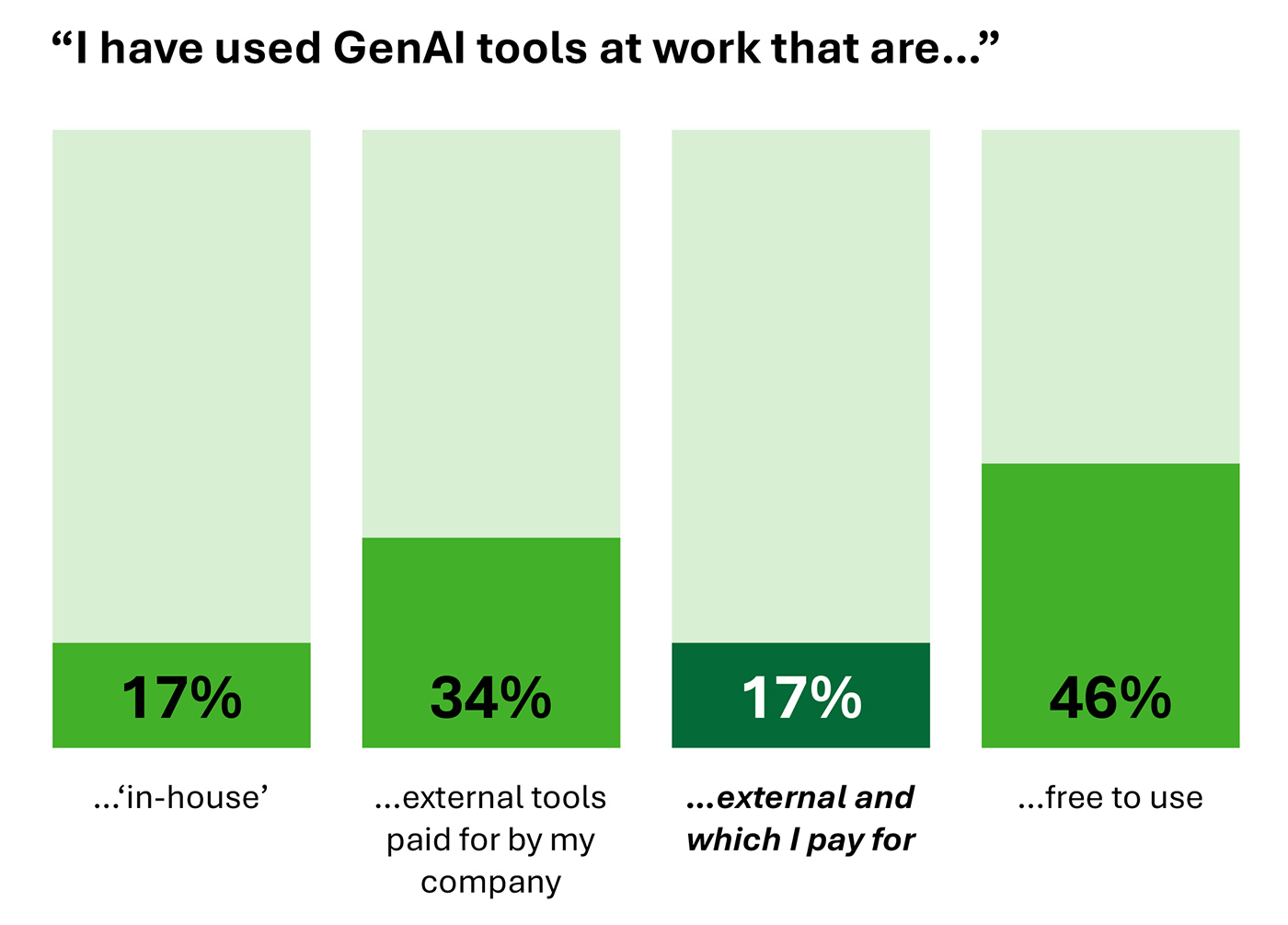
Deloitte’s report estimates that only 17% of employees have access to in-house tools, while 34% use external tools paid for by the company. And while 46% source free-to-use tools, some 17% are paying to use external software. Deloitte determines this means UK staff are spending a collective £958 million annually on the GenAI tools they use for work.
What they get for that expense is also a matter of concern. Some 32% of staff said GenAI at work actually saves them time. Of that, 7% said it saved them upwards of five hours per week, while 14% said it saved no more than two. In contrast, a further 18% said GenAI was not time-saving – though they thought it might be in the future – while 9% did not ever expect to save time this way. And 4% simply had no idea either way.
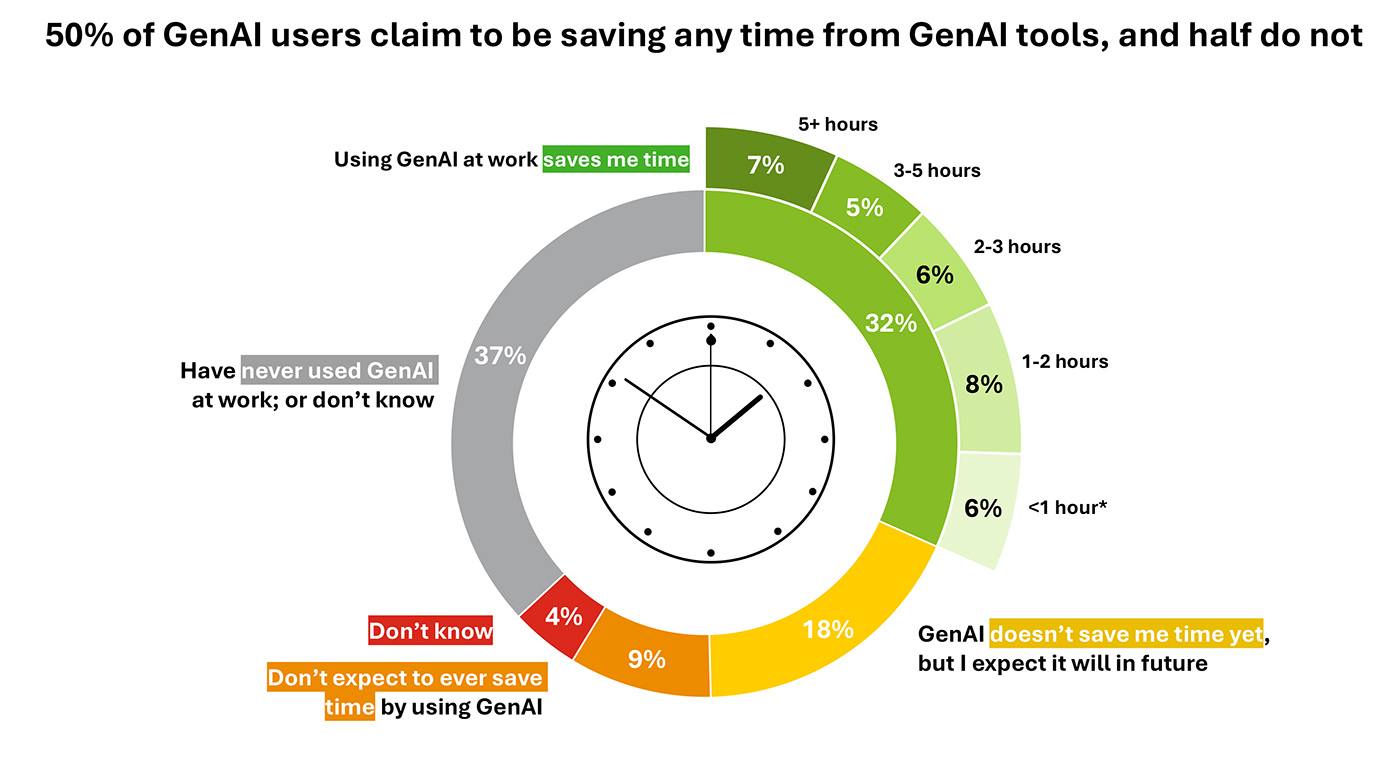
When staff used AI tools, then, there was a 50:50 chance that they would noticeably free up time at work. Considering the findings of another recent survey from Korn Ferry – polling more than 16,000 professionals across 11 global markets – that does not bode well for overall productivity boosts resulting from employers’ laissez faire approach to AI adoption.
That study found a 52% majority of employees believed AI tools had increased tasks instead of reducing workloads. Connected to this, 62% said their workload has increased significantly over the past two years, with 44% of employees reporting they feel stretched beyond their capabilities, and 45% now too busy to deliver meaningful results. And with workers under pressure – while also dealing with additional financial strains – this could be even worse for productivity. Without a more determined form of leadership on this front, firms risk the irony of working harder not smarter, in an age of smart devices.
Hayley McKelvey, chief AI officer at Deloitte UK, said, “The challenge is no longer getting people to use GenAI, it’s how businesses meet this growing demand in a way that is secure, responsible and creates lasting value for both the organisation and its people. Leaders should help their people use AI responsibly, with a clearly articulated and well-understood goal. That means being clear about why their workforce should use GenAI, how it should be used and what success looks like. This will help people use the tools more consciously, make better decisions, manage risks and add value.’’