Sustainability funding slows ahead of Scope 3 reckoning

Early progress on the road to net zero showed dramatic results, with firms racking up quick wins to downsize their carbon footprints. But a new L.E.K. Consulting study suggests that the hardest work is still to be done – at a time when investment in sustainability seems to have already peaked.
Research from KPMG in 2023 found that since 2005, the UK had seen carbon emissions in its energy and waste sectors plummet by 64%. Energy excluding electricity had also seen a 46% fall. Those were huge leaps forward in the nation’s sustainability drive – but the Big Four researchers still cautioned that the country faced an uphill battle to reduce emissions on transport, buildings, and industry. Those three sectors made up 60% of all greenhouse emissions in 2022, yet had seen comparatively little progress. At the same time, while 61% of manufacturers were unsure when asked if they could hit their 2030 targets, that industry had only reduced emissions by 36% since 2005.
Two years on, a study from L.E.K. Consulting has similarly sounded the alarm, that while the early stages of the world’s transition to a decarbonised economy might have enjoyed early wins, the hardest part is still to come. L.E.K. carried out its own global analysis in 2023, and has checked back in 2025, to find that amid pressure to take responsibility for Scope 3 supply chain emissions, the majority of businesses are delaying Scope 1 and 2 net zero targets.
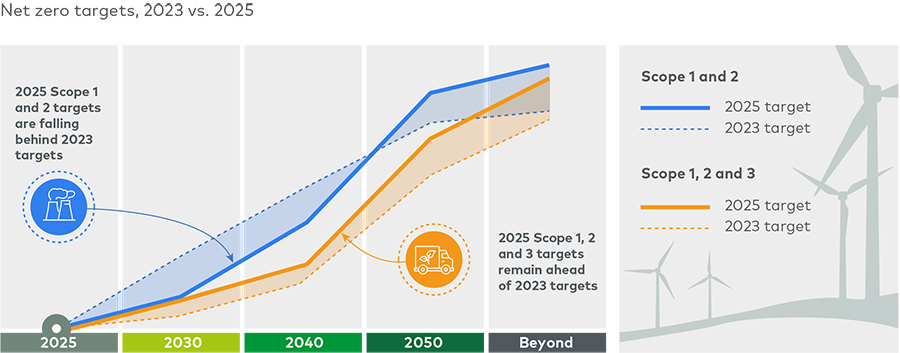
While companies were responding to stakeholders demanding they take responsibility for their supply chain emissions, the researchers found that few were confident on this front. In spite of a growing mountain of research having warned businesses they need to start planning how to tackle Scope 3 emissions, one-in-three respondents told L.E.K. that they still felt unequipped to handle it.
This seems unlikely to improve quickly, as while 78% said they struggled with Scope 3 accountability due to supplier contract challenges, and 45% said they thought digital supply chain sustainability would become a major concern in three years; just 24% said they had actually made improving supply chain oversight a top priority.
Investment pressures
As a result of this, it is hard to gage how genuine the progress being made on either front has been. While a growing number of firms believe they are ahead of schedule for their Scope 3 targets compared to 2023, many of those firms may be unclear on the true extent of their Scope 3 submissions. At the same time, they are taking their eyes off the ball on other fronts, with L.E.K. finding that their Scope 1 and 2 targets are falling behind those of 2023.
Just as firms face this crucial juncture in their sustainability journey, L.E.K. has also found that funding may be plateauing for their further initiatives. While the researchers found that sustainability investment has grown over the past three years, with 57% of respondents increasing their spending by over 5%, narrowing that timeline down shows a worrying trend.
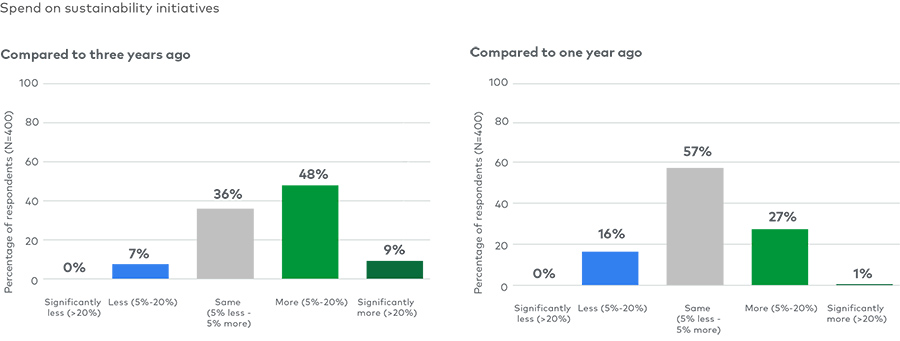
Over the past 12 months, momentum has stalled, with 57% of corporates reporting the same spend as the year before – while 16% – up from 7% over the three year period – say they are spending less. L.E.K. suggested that macro conditions such as rising interest rates and political changes have likely caused the pause in activity, while insisting long-term intent is still strong, as 55% plan to increase investment over the next three years. But macro conditions look unlikely to improve over that same spell – suggesting there is also a chance this trend continues.
Firms may be missing a trick on that front, though. By approaching sustainability as a business imperative, rather than a compliance matter, they could open up multiple opportunities, according to L.E.K. A 57% majority have positive returns on sustainability investments – of those, 59% said they enjoy increased energy efficiency as a major plus (not something to be sniffed at in a geopolitical order where energy prices are prone to wild fluctuation).
The researchers added, “For real impact, companies must treat Scope 3 as a commercial strategy issue, not a compliance task. That means focusing on initiatives that align environmental outcomes with financial logic and dropping low-impact actions that dilute execution. Strategic clarity – knowing what not to pursue – is just as critical as ambition.”