Businesses cannot be left to self-regulate on sustainability, experts conclude
Nine-in-ten sustainability experts believe the world’s current approach to sustainability is not working, while half back radical changes to it. Around half now say that increasing levels of regulation and enforcement on climate commitments could be the most viable way to ensure organisations go beyond the greenwashing which has characterised the last decade.
Signed in 2016, the Paris Agreement committed the international community to targeting a best-case scenario, where global temperature rises linked to the burning of fossil fuels hit a maximum of 1.5C. But while businesses used the opportunity to make grand promises that might encourage consumers to view them more favourably, the road to net zero in reality has been a slow one. Even as the likelihood of keeping 1.5C alive fades away.
In 2024, the EU’s climate service reported that global temperatures had breached the 1.5C barrier for the whole previous year. The following 12 months blazed past that, becoming the hottest year on record – and while scientists maintain the point of no return has not quite been reached, recent research has suggested the Earth has only two years left of its ‘carbon budget’, and that the planet is currently on course for heating of 2.7C; even higher than the Paris Agreement’s upper-limit of 2C.
Amid this, the idea that organisations could be left to self-regulate, because averting a climate Armageddon is in their financial interests, has seemed less and less cogent. With top companies facing estimated annual losses of a combined $1 trillion, corporate interests are still dragging their feet, when it comes to living up to their pledges on sustainability.
Now, a new survey of sustainability experts by global ESG consultancy ERM suggests a tipping point has been reached. When the firm asked 844 experts across 72 countries what they made of the world’s current sustainability approaches, the majority no longer see the status quo as fit for purpose.
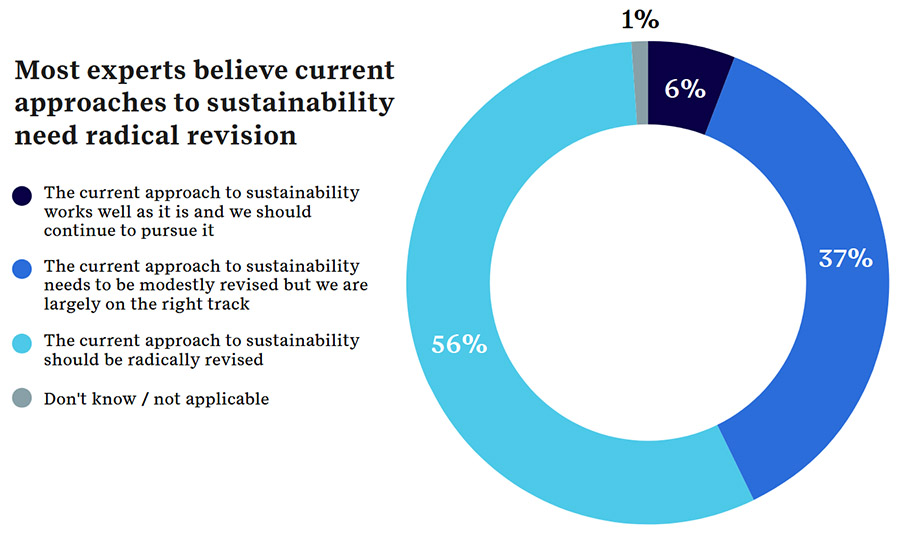
When asked how they felt about the sustainability agenda is it currently is, only 6% said it was working well and should be unchanged. And while 37% still believed incremental change was relevant and desirable – saying the current approach should be revised, but was broadly on the right track – a 56% chunk of the experts polled favoured ‘radical revision’ of the current approach to sustainability.

With a similar 50% saying the progress made on sustainability leading up to 2025 had been ‘poor’, ERM asked where change was needed most. While 48% of experts identified the private sector as a top problem, and 52% cited institutional investors, however, a 63% majority of experts laid the blame largely at the door of national governments.
This might also explain why the experts see governmental efforts as being key to getting things back on track. Education remains a key aspect of these efforts – but at this stage, there is clearly only so much that disseminating accurate information can do as motivation. So, when it comes to giving the private sector and its investors the kick up the backside they need, experts said they felt that regulations and enforcement would now be the best civil society actions to focus on in the coming five years.
To that end, 58% of experts said advocacy for better government policies, regulations and enforcement were now a priority (just 1% behind education and capacity-building for sustainability leadership). And even amid political turmoil, where politicians have become increasingly hostile to sustainability in the US and Europe, this was still seen as one of the most viable ways of pressuring for change – with 41% of experts citing calls for regulations as being viable. This made it a top possibility, alongside education, and using NGO campaigns to target poor business sustainability performance.