Quarter of UK companies could have Companies House discrepancies, study suggests

With the end of the transition period for mandatory Companies House identity verification, new research has raised concerns over the accuracy of the UK’s corporate register. A new study from Board Intelligence suggests more than one-in-four firms could have at least one kind of discrepancy in their Companies House filings, while highlighting the need to use technology to identify and act on problems quickly, ensuring good governance ahead of time.
The Economic Crime and Corporate Transparency Act (ECCTA) requires all directors, persons with significant control, and LLP members to verify their identity with Companies House by 18 November 2026. Regulations like this highlight the link between robust records and a robust financial system. But they also add to the governance team’s load.
To understand what entity management looks like in the UK today, Board Intelligence surveyed 200 company secretaries and general counsel, most of whom oversee more than 1,000 legal entities; and the study quickly highlighted the scale of the challenge. Every governance professional surveyed said their organisation had experienced at least one problem in the past two years linked to entity information, including delayed transactions, audit findings, late statutory filings, and financial penalties.
Among the headline figures, Board Intelligence found 33% had found an error in a Companies House record about their organisation in the previous two years. Meanwhile, 31% had experienced delays to a transaction, financing, or account opening linked to incomplete, inaccurate, or difficult-to-access entity information, while the same proportion had encountered a dispute over which record was correct. On top of this, 28% reported an audit or assurance finding, and the same proportion said a director appointment or resignation had been recorded late. A further 21% admitted they had filed a statutory return late, and 20% said their organisation had received a penalty or fine.
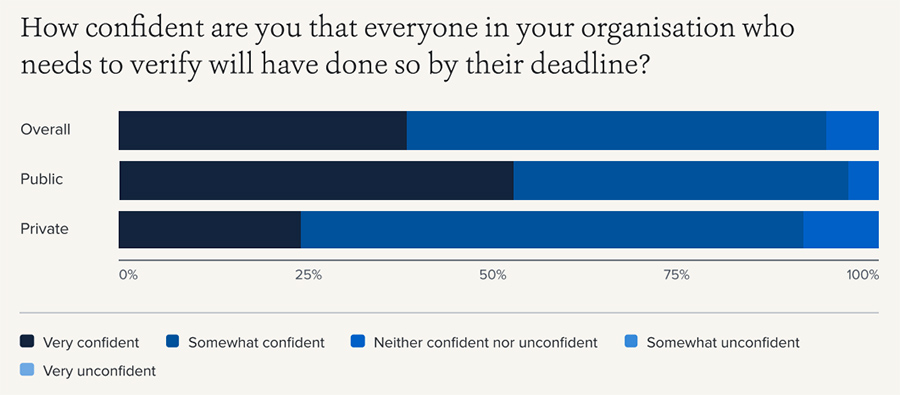
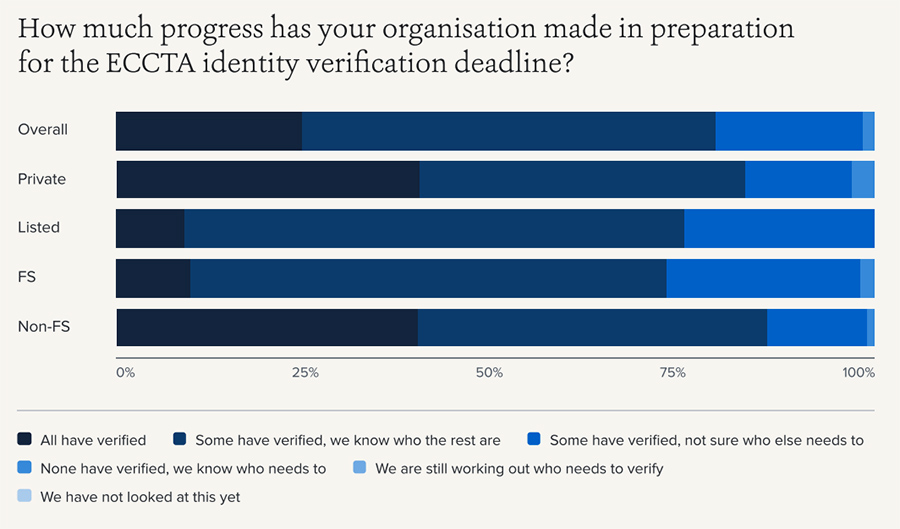
Worse, large portions of companies are unsure how close they are to compliance with the new Companies House rules. The large majority of companies were confident that everyone in their organisation would verify by the deadline. But when asked how much progress they had made to prepare for the ECCTA identity verification deadline, this confidence seemed to dry up. Just under a quarter of all those surveyed said they either had some verification, but were unsure which departments were still outstanding; or were still verifying who needed to verify in the first place.
Pippa Begg, CEO of Board Intelligence, said of the findings, “When corporate records are incomplete, outdated, or hard to access, the consequences are felt in transactions, audits, and the boardroom. Boards and leadership teams need confidence in this data and the workflows around it. Too often, that assurance depends on people stitching together information from documents, systems, registries, and colleagues. For governance teams already stretched thin, that is a real challenge. The goal should be continuous control: giving organisations a trusted, dynamic view of their structure, responsibilities, and obligations, without waiting for a transaction, filing, or regulatory deadline to expose a problem.”
Experts warn that failing to act quickly could result in a number of issues for companies going forward. While fines are one of the risks, the consequences can be more serious depending on the nature of the breach. Companies House can impose financial penalties and pursue criminal prosecutions, while persistent non-compliance with filing obligations can also lead to companies being struck off the register or directors being disqualified through the courts. For example, 360 directors were convicted for filing offences in the first three months of 2026 alone, although these cases involved failures to file accounts or confirmation statements rather than inaccurate records.
With enforcement activity set to climb further with the changes, Meg Ogunsola, global head of entity management at Vistra, commented, “The introduction of new identity verification requirements has brought these challenges into sharper focus. Companies have already put considerable work into preparing for the changes, but compliance cannot be treated as a one-off exercise. With Companies House taking a more active role in scrutinising corporate information, businesses need to make accurate record-keeping part of their everyday operations.”
According to Ogunsola, the fact that so many businesses have found discrepancies in their Companies House records “highlights just how difficult it can be to maintain accurate corporate information”. For large multinationals, the challenge is particularly acute, with hundreds of entities, directors and ownership structures spread across different jurisdictions – and “information is often held across multiple teams and systems, making it difficult to maintain a complete, up-to-date picture.” To do that, companies must move away from “fragmented spreadsheets and manual processes, establishing clear accountability and using technology to identify discrepancies before they become bigger problems.”
A Companies House spokesperson meanwhile stated, “Directors are legally responsible for ensuring a company keeps its information on the Companies House register accurate and up to date. Our objective is to ensure data on the register is accurate. Identity verification helps to create more complete, accurate and dependable records. Thousands of companies have contacted us to make sure information on the register matches verified identity documentation. That is exactly the type of behaviour we wanted to encourage.”