Performance optimisation remains top priority for payment strategies

A new era of differentiation means that many retail vendors are looking to build a stack of payment service providers, rather than selecting a single provider. However, the change requires a different set of skills on the part of the firm’s payments team, to make the most of this portfolio of services.
A payment service provider is a third-party company that allows businesses to accept electronic payments, such as credit card and debit card payments. PSPs act as intermediaries between those who make payments, and those who accept them. For two decades, the dominant logic of enterprise payments was consolidation – with retailers picking a strong primary PSP, integrating it deeply, and letting the relationship compound.
According to PaymentGenes, however, that logic is breaking. Only 19% of enterprise merchants still run a single PSP, and more than 80% have moved beyond, or are actively moving beyond, the single-provider model.
PaymentGenes’ first Merchants Pulse study meanwhile found that 84% of merchants are considering adding or switching a provider within 24 months. Complicating the picture, however, the researchers assert that “very few of them will”. Integration complexity, internal resourcing and business disruption risk form a wall of operational friction that keeps merchants tethered to providers they would otherwise replace.
What merchants build instead
As a result, many merchants now favour additional PSP deals. Orchestration, multi-acquiring, tokenisation, routing, reconciliation, all yield a stack assembled one layer at a time, each justified on its own terms, none designed as a whole. And two-thirds of merchants already have orchestration live or committed, while roughly three-quarters are on the same path for multi-acquiring. On paper, this is a market that has turned toward optionality.
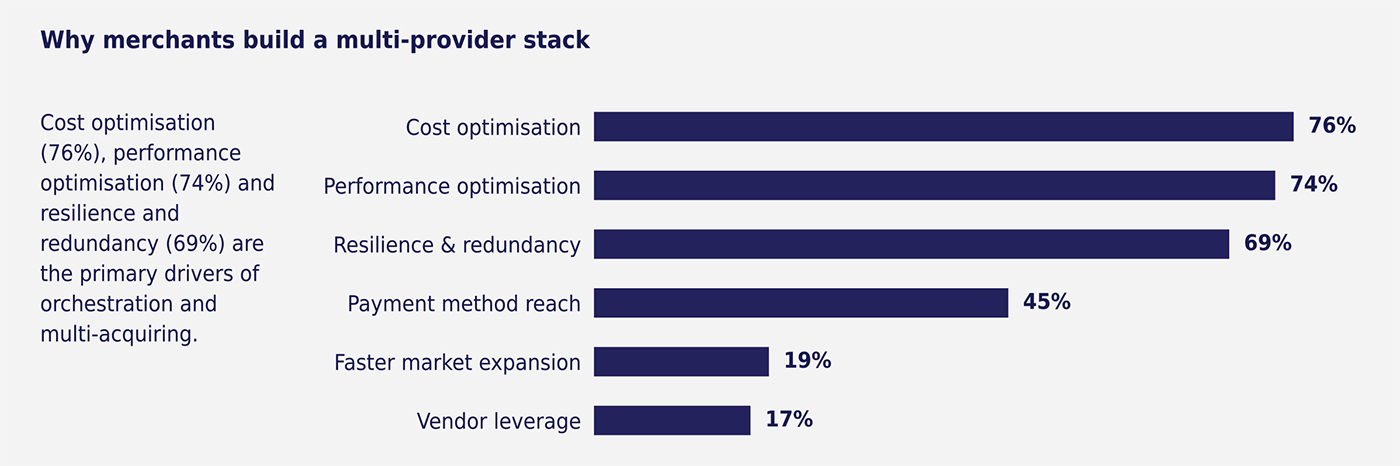
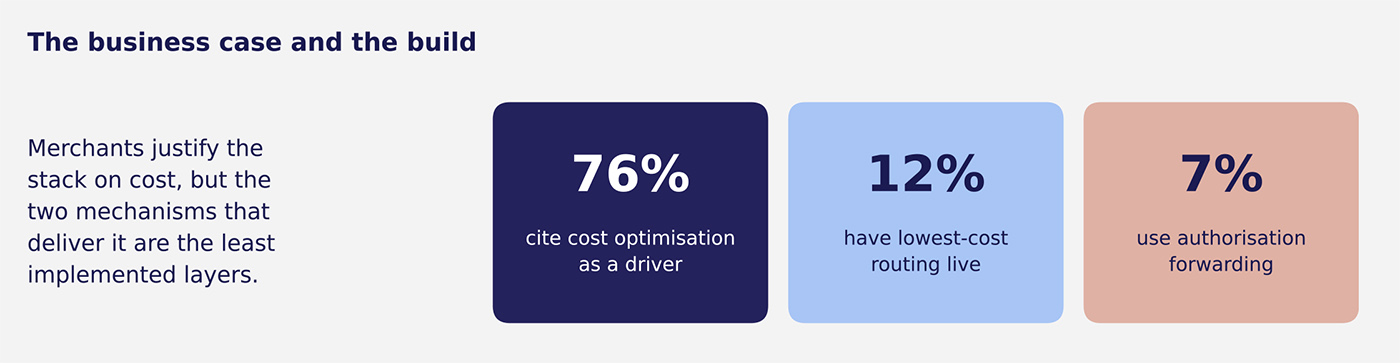
However, according to PaymentGenes, the implementation data tells a more careful story. While merchants overwhelmingly say they build a multi-provider stack for cost optimisation, very few have switched on the mechanism that delivers that. The gap between the business case and the build is the single most striking finding in the report, and it means a large share of enterprise merchants are carrying the complexity of a portfolio without collecting the return.
There is a quieter problem underneath, impacting those efforts. Merchants told the researchers that migration difficulty is what stops them acting on switching intent. Yet the majority are, through ordinary day-to-day architecture decisions, making that difficulty worse. The credential layer is where diversification quietly stops, and most organisations have not looked at it closely.
Nearly half of enterprise merchants run their entire payments estate with fewer than five dedicated people. Against that sits a three-year investment agenda of five parallel priorities, each of which becomes an operating requirement the day it goes live.
The technology is available to everyone. What separates merchants now is whether they can run what they have bought. The payments team’s ability to execute on the technology and to activate other company departments becomes a differentiator.
The researchers explained that capacity, not capability, is now the binding constraint. While the market has solved the technology question, what separates merchants is whether they can operate what they have bought, which makes sequencing, tooling and team design the strategic decisions of the next cycle, not the administrative ones. Merchants went shopping and came home with a portfolio. According to the experts, the work now is to make it run as one system rather than several, and to be honest about which layers are earning their keep.
Ward Hagenaar, managing partner and co-founder of PaymentGenes, commented, "Our research showed that most merchants lack capacity to execute on their longer-term payment strategies. This results in smaller strategic steps, adding orchestration and multi-acquiring before executing on their end goals."