‘Connected’ systems mean UK professional services firms outperform global average on unplanned work

Across a typical project, around a third of allocated time is unplanned, while professional services firms estimate that around a tenth of project revenue is lost to resulting inefficiency, a new paper from Unit4 finds. Looking at economies across Europe and North America, the study found that more than two-thirds of UK firms reported unplanned work had increased in the last year; but US and German counterparts were significantly worse off.
Unplanned work happens no matter how much organisations try to plan for every eventuality. It could refer to anything from support escalations to emergency outages, feature requests coming in sideways, or changes in stakeholder demand. This type of work can present several challenges to product managers and their cross-functional teams – impacting the ability to deliver other forms of value, or resulting in unsustainable work practices and an unhealthy culture.
In the age of agile digital transformations, hurried AI implementations, and economic uncertainty, unplanned work is more common than ever, too. Unit4 conducted a comparative poll in the UK, US, Belgium, Germany, the Netherlands and Sweden – and found that around 30% of professional services firms’ allocated time is unplanned. With the issues this creates, project managers anticipate this sees 8% of project revenue lost to inefficiency – a major issue at a time when the professional services sector is looking to counter flat growth.
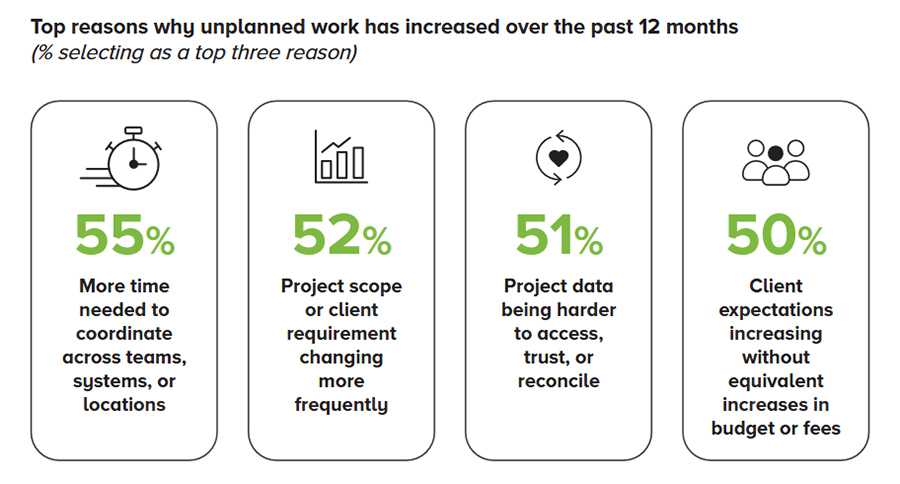
Unit4 then asked the international cohort of professionals what the top three reasons were for this shift. A 55% majority identified the time needed to coordinate across teams, systems, or locations as a leading drain on resources – as the seemingly endless cycle of digital and AI transformation tests organisational alignment to the maximum. Meanwhile, 52% said project scope or client requirements were changing more regularly, in-keeping with the volatile nature of the economy, and technological advances. And 51% said that project data was now harder to access, trust or reconcile – something potentially tied to the rise of AI, which generates large amounts of data that can be inaccurate, potentially corrupting other data sets.
Causes and solutions
The issue may not lie entirely with technology, or market volatility, though. Unit4 suggested that a failure to plan a base-system, on top of which unified transformations can be built, was a key contributor to value being lost to unplanned work.
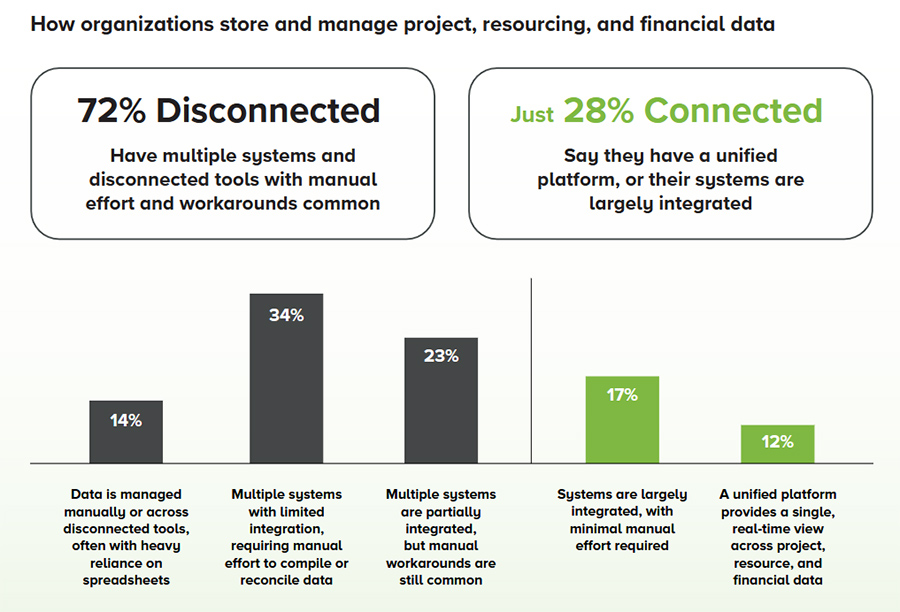
Only 28% of businesses polled said they currently have ‘connected’ status – with 17% saying they have systems that are largely integrated, with minimal manual effort required to communicate change across an organisation; and 12% saying they had a single unified ERP platform to coordinate across project, resource and financial data. In contrast, almost three-quarters of businesses were ‘disconnected’, including 34% who have multiple systems with limited integration, and 23% who have only partial integration. This means manual workarounds to coordinate change remain the most common mode of project management – costing time and resources, while squandering potential value.
Unplanned work is not adding the same level of pressure across all geographies, however. Most European countries saw around 80% of firms reporting that the amount of unplanned work has increased over the past 12 month, along with the US on 82%, and Germany worst off at 91%. However, that fell to just 69% in the UK – a lower also 56% said a significant proportion of their working time is wasted on low-value activities, far better than any of their counterparts, including the US on 72%; or Germany on 68%. Again, the key ‘connectivity’ – with 54% of UK firms relying on multiple ‘disconnected’ systems, compared to the US on 73%; or Germany on 82%.
According to Unit4, these ‘connected’ firms are more than twice as likely to manage performance proactively or predictively (76% vs. 31%), while 79% of disconnected organisations regularly reverse or revisit decisions made with incomplete data (compared with 43% of connected firms). 94% also believe AI-enabled tools could improve project decisions, but just 26% are using AI widely across multiple areas.
“The difference between connected and disconnected organisations is increasingly visible in how quickly and confidently professional services firms can make decisions and keep projects on track,” said Donna Dobson, global director for professional services at Unit4. “In the UK, over half of firms still lack an integrated view of project, resource and financial data, whereas firms with connected systems are reducing the drag of unplanned work and low-value activity to give teams greater visibility and control over performance. The message is clear: integration is no longer simply an IT priority, it is becoming a competitive advantage for firms looking to protect margins, improve delivery and create capacity for growth.”