Less than fifth of UK businesses consider ex-offenders for open roles

While businesses maintain they are facing a ‘skills shortage’, many are still neglecting recruitment among a long-overlooked segment of the talent pool: ex-offenders. According to a new study from DSA Connect, less than one-fifth of UK firms have specific policies in place offering a second chance to those with a criminal record.
Depending on who you ask, there is not a lot of difference between a CEO and a burglar. Reworkings of the old joke suggest the main dividers are things like a suit, or an MBA. Among certain quarters, CEO is considered short for Chief Embezzlement Officer.
But despite these apparent commonalities, the corporate world still shows little empathy toward former offenders. A 26% portion of business leaders would be to some degree comfortable with hiring someone with a criminal record. But 29% said they would be uncomfortable, and 6% would refuse to employ anyone with a record – while a further 30% told researchers from DSA Connect they had no opinion either way.
Of course, there are roles that are not applicable to someone with a criminal record – particularly involving care, or work with vulnerable people. At the same time, some convictions will put people more on edge than others – and the research does not make clear how highly these matters factored into responses. However, even in that case, given that many convictions in the UK are for non-violent offences, the responses are hardly a glowing vote of confidence in reformed individuals.
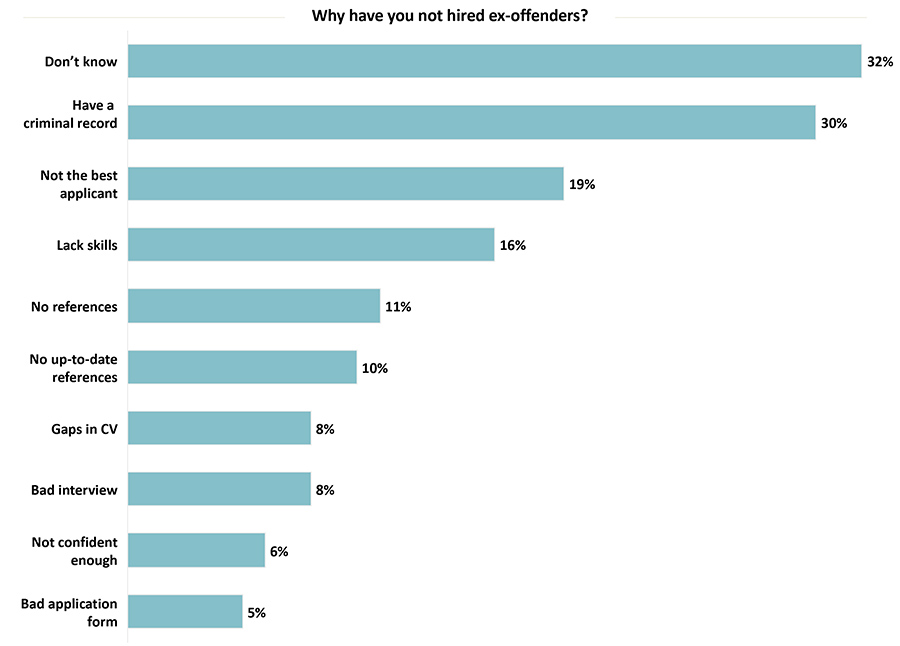
But when polled as to why they held these prejudices, many came up short. While 19% specified ex-offenders had not been “the best applicant for the job”, 16% cited a lack of skills, and 11% said they had no references (which seems pointedly obtuse to expect of someone they knew was recently incarcerated) – many more could not put their finger on something specific. A 30% portion vaguely said a criminal record was just the reason they had not hired ex-offenders, while the largest chunk of 32% admitted they had no idea why they’d never hired someone from that background.
Skills shortage
IT asset disposal company DSA Connect runs programmes to support prisoners in developing new work skills and to find employment, and its researchers argued that this attitude means businesses are missing out on the range of skills and quality work that ex-offenders can bring.
Having surveyed 1,100 businesses with a combined turnover of £15.9 billion, the study found that 51% were experiencing a skills shortage. Of these, 24% of employers said they are struggling to recruit people with the right skills and experience they need right now, and 27% said they have faced this in the past and may do again in the future. But the top benefit given by employers who have recruited ex-offenders is finding workers with the right skills and experience for the job, however many businesses are missing out by failing to implement a recruitment policy that actively targets ex-offenders.
Among the 16% that do proactively target recruiting ex-offenders, 62% currently employ ex-offenders or have done so in the past. And contrary to many stereotypical views, 95% of these businesses say they were generally pleased with the quality of the work carried out by ex-offenders. Over a third of businesses said they’ve generally found ex-offenders work to be ‘excellent’, while another 49% said it was ‘good’.
Harry Benham, chair at DSA Connect said, “Our new research highlights that particularly when facing a skills shortage, many UK businesses are missing out on valuable employees by not having a recruitment policy to hire ex-offenders. All too often this is simply due to stereotypes and stigma surrounding hiring people with a criminal record or who have been in prison, and the research highlights that many businesses don’t know why they’ve never hired an ex-offender… It is a fact that, if a person leaving prison has employment, they are far less likely to re-offend and re-offending, according to government statistics, costs the country an estimated £18 billion per year!”